
Hire an installer who preps the concrete before they ever open a bucket of coating, and match the coating system to how the space actually gets used, not how it looks in a brochure. Skip the DIY kit and skip the contractor who quotes you a price over the phone without seeing the slab. Aircraft hangar epoxy flooring, garage epoxy flooring, whatever you call it, the winning formula is the same: mechanical surface prep first, the right system second, a warranty in writing third.
Before you sign anything, request three things from any installer:
- A site visit to assess your slab's condition and existing coatings
- A moisture test using ASTM F1869 (calcium chloride) or an in-situ RH probe
- A written diamond-grinding prep plan that names a target Concrete Surface Profile (CSP)
Show Me Epoxy builds every quote around those three checkpoints, because a coating is only as good as the concrete underneath it.
Key Takeaways
A durable epoxy floor depends on mechanical surface prep, verified moisture testing, and a coating system matched to real traffic and chemical exposure, not price or color.
| Point | Details |
|---|---|
| Prep beats products | Diamond grinding or shot blasting to the right CSP matters more than which epoxy brand you choose. |
| Test moisture first | ASTM F1869 or F2170 results should come before any prep work is considered final. |
| Match system to use | Thin-film for light traffic, mortar or broadcast systems for forklifts and heavy impact. |
| Vet before you sign | Ask about CSP targets, DFT, mock-ups, and written warranty scope before hiring. |
| Show Me Epoxy | Leads with diamond-grinding prep, manufacturer-backed materials, and written warranties on every install. |
Table of Contents
- Why a Professional Installer Beats a DIY Epoxy Kit
- Which Epoxy System Fits Your Space?
- How Does Surface Prep Actually Get Done?
- Do You Need a Moisture Test Before Coating?
- What Does an Epoxy Floor Installation Actually Cost and Take?
- What Questions Should You Ask Before Hiring an Installer?
- How Long Does an Epoxy Floor Really Last?
- How Show Me Epoxy Approaches Every Project
- Ready for a Floor That Actually Holds Up?
- Sources
Why a Professional Installer Beats a DIY Epoxy Kit
Professional installers deliver three things a big-box kit never will: mechanical surface prep, moisture testing, and a system chosen for your specific slab conditions. Diamond grinding or shot blasting opens the concrete's pore structure so the epoxy actually bonds to it, rather than sitting on top of dust and laitance like most rolled-on kits do.
A legitimate installer will also run a mock-up and a pull-off adhesion test on part of the floor, check for manufacturer certification on the products they're using, and put the warranty terms in writing before work starts.
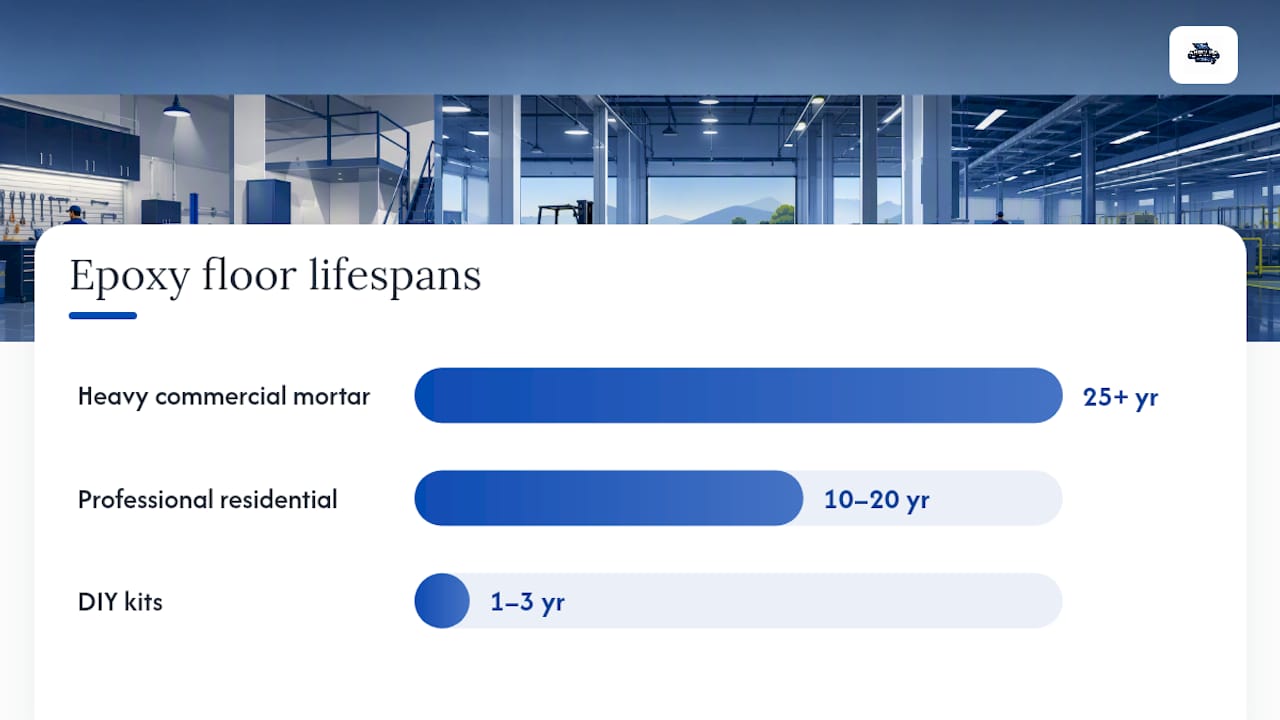
The lifespan gap tells the real story. Professional-grade installations that use 100% solids products and mechanical prep commonly last 10 to 20 years or more in a residential garage. Retail DIY kits, applied over acid-etched (not ground) concrete with thin, water-based formulas, frequently fail within 1 to 3 years, usually through peeling, hot-tire lifting, or blistering.
- Pro install: ground or shot-blasted substrate, 100% solids epoxy, documented CSP, written warranty
- DIY kit: acid-etched or unprepped substrate, thin water-based coating, no moisture test, no recourse when it peels
Which Epoxy System Fits Your Space?
The system you need depends on what rolls, walks, or spills across that floor, not the color chart. A residential garage floor and a commercial shop floor with a forklift are not the same engineering problem, and installers who skip that conversation are setting you up for an early recoat.
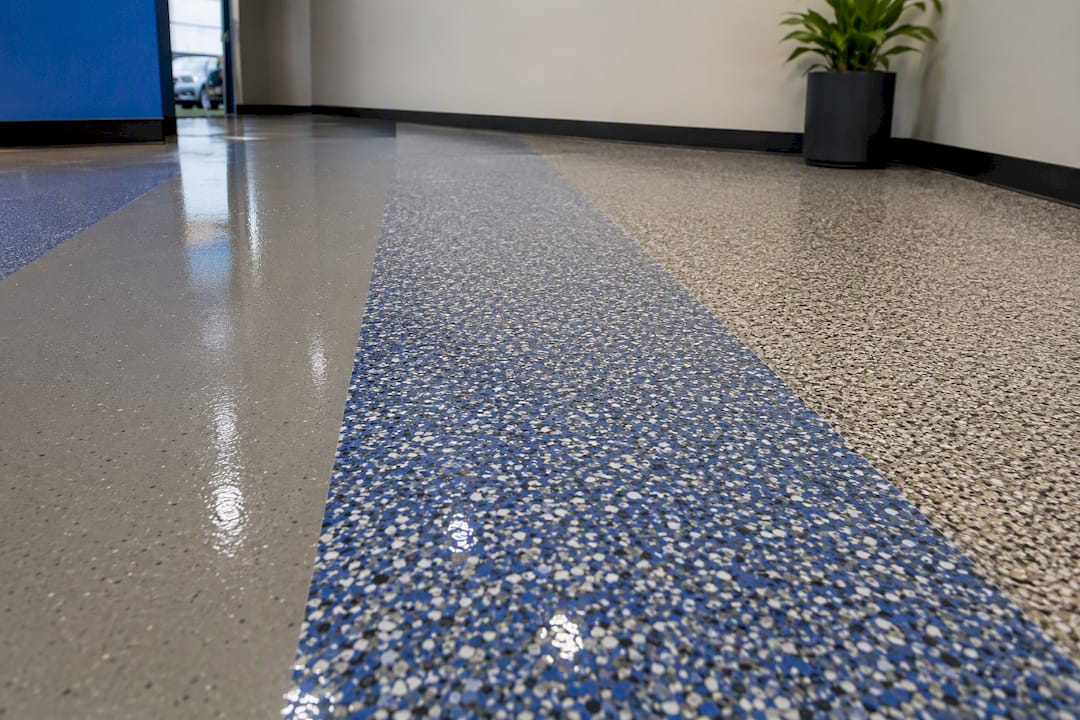
Thin-film epoxy works for light foot traffic and decorative garage floors where looks matter more than load. Flake broadcast systems add texture and slip resistance while hiding minor slab imperfections. Quartz broadcast systems bring more chemical resistance and a tighter, more uniform finish, often specified in commercial kitchens or labs. Epoxy mortar or self-leveling systems build serious thickness for forklift traffic and point loads. Polyaspartic or polyurea topcoats cure fast and hold up to UV exposure, which matters for patios and any space that sees direct sunlight.
| System | Best for | Performance focus |
|---|---|---|
| Thin-film epoxy | Light foot traffic, decorative garages | Appearance, moderate durability |
| Flake broadcast | Garages, basements, showrooms | Slip resistance, texture |
| Quartz broadcast | Commercial kitchens, retail | Chemical resistance, uniform finish |
| Epoxy mortar / self-leveling | Warehouses, forklift traffic | Thickness, impact resistance |
| Polyaspartic / polyurea topcoat | Patios, fast-turnaround commercial | UV stability, quick cure |
How Does Surface Prep Actually Get Done?
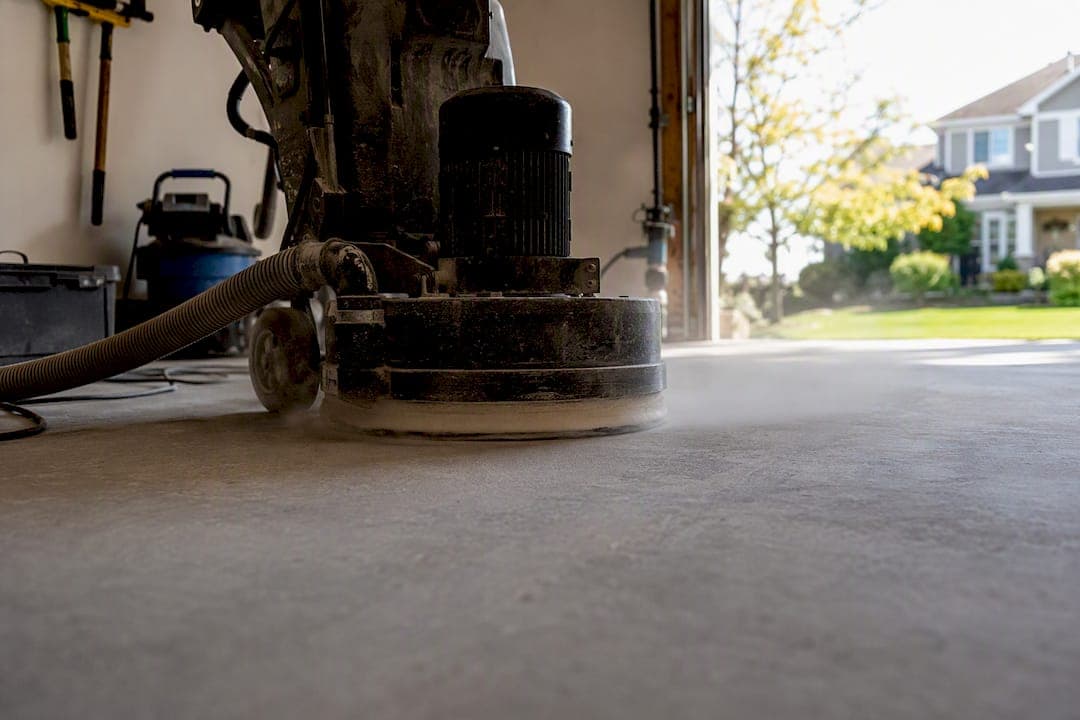
Mechanical prep is the single factor that decides whether your coating lasts a decade or peels inside a year. Diamond grinding and shot blasting both remove the weak top layer of concrete and open a mechanical profile the epoxy can grip. Grinding suits tighter spaces and edge work; shot blasting covers large open floors faster and leaves a more aggressive texture.
Tool choice scales with square footage. A 100 to 500 square foot garage calls for a 7 to 9 inch walk-behind grinder or a hand-held angle grinder with a diamond cup wheel, brands like Bosch and Metabo both make solid options here. Jump to 500 to 1,200 square feet and an 18 to 21 inch dual-disc walk-behind, the kind Husqvarna, EDCO, or Lavina build, makes more sense. Anything above 1,200 square feet usually gets a planetary grinder run by a crew that grinds concrete for a living.
Grit progression follows a set order for good reason:
| Stage | Grit range | Goal |
|---|---|---|
| Removal | coarse grit | Strip coatings, laitance, contamination |
| Bulk grind | medium grit | Level the surface, open the profile |
| Profile pass | fine grit | Hit CSP 2 to 3 for thin epoxy, CSP 3 to 4 for polyaspartic |
That order isn't arbitrary. Diamond bonds run harder-to-softer as grit climbs, and skipping steps burns through discs and leaves a profile too shallow for the coating you're installing.
Dust control isn't optional. Grinding without a shroud and a HEPA-rated extractor throws respirable silica well past OSHA's permissible exposure limit, which is why legitimate crews run extractors from brands like Pulse-Bac or Ermator matched to the grinder's CFM, plus fit-tested respirators for the crew.
Pro Tip: Ask your installer to grind in overlapping passes with roughly 50% overlap in a cross-hatch pattern. A single-direction pass leaves streaks in the profile that show up as inconsistent gloss once the topcoat cures.
Verification is quick: the ground surface should read as a uniform matte gray, no shiny burnished spots, and a CSP comparison chip should match the target profile visually.
Do You Need a Moisture Test Before Coating?
Yes, and skipping it is how blisters and delamination happen months after installation looks perfect. Installers run either ASTM F1869 (calcium chloride, measuring moisture emission) or ASTM F2170 (an in-situ relative humidity probe).
- Test before any prep work finishes. A failed reading changes the entire plan.
- If moisture fails, the installer either mitigates with a vapor-barrier primer or delays the job until the slab dries.
- Repair static cracks with rigid epoxy fill.
- Treat dynamic joints with semi-rigid polyurethane, or leave them as a properly detailed control joint rather than filling them solid.
- Skip conventional concrete patch in favor of epoxy mortar for any spalls or divots.
- Respect the 28-day cure rule on new concrete pours before coating, no exceptions worth the risk.
What Does an Epoxy Floor Installation Actually Cost and Take?
A typical job runs through five phases: assessment, mechanical prep, primer or build coats, broadcast or topcoat, and cure. Commercial jobs often need 1 to 2 weeks of planning before crews arrive, then 1 to 2 days for prep, 2 to 5 days for body coats, and 1 to 5 days for topcoat and cure.
- Assessment and planning
- Mechanical surface prep (grinding or shot blasting)
- Primer and build coats
- Broadcast or flake application, if specified
- Topcoat application and cure
Cost scales with system complexity and square footage. Thin-film epoxy runs cheapest per square foot; mortar and multi-layer flake systems cost more up front but stretch service life well beyond a basic coating. For a single garage, renting grinding equipment yourself can save money on paper, but most homeowners underestimate the learning curve on grit progression and dust control, and a botched grind means redoing the whole job.
- Light foot traffic typically resumes 24 to 72 hours after the final coat
- Vehicle traffic usually waits 5 to 7 days
- Full chemical resistance often takes longer to develop fully, even after the floor looks cured
What Questions Should You Ask Before Hiring an Installer?
Ask these before you sign a contract, not after the crew shows up:
- What surface prep method will you use, and what CSP are you targeting?
- Can I see your moisture test results before coating begins?
- What's the exact product spec, including dry film thickness (DFT)?
- Will you run a mock-up and pull-off adhesion test first?
- What's covered under warranty, and for how long?
- Are you insured and certified by the coating manufacturer?
Red flags are just as telling:
- They mention acid etching but never diamond grinding or shot blasting
- The quote has no moisture testing line item at all
- There's no mock-up or written CSP target
- They push a DIY kit as a "just as good" alternative
- They offer a "lifetime warranty" with no written scope defining what it covers
Your written quote should spell out the layer-by-layer system, DFT for each coat, references to the manufacturer's technical data sheet, recoat windows, and a realistic schedule.
How Long Does an Epoxy Floor Really Last?
Maintenance is light: sweep regularly, mop with a pH-neutral cleaner, and skip harsh solvents that can dull the topcoat over time. Spot-repair chips or deep scratches as they happen rather than waiting for them to spread.
Lifespan depends heavily on the system and the prep behind it. Professional residential flake or solid systems commonly run 10 to 20 years, heavy commercial mortar systems can push past 25 years under the right conditions, and DIY kits often fail in 1 to 3 years. A maintenance topcoat every several years usually costs a fraction of a full tear-out and reinstall.
- Clean with a soft-bristle broom and pH-neutral cleaner
- Reapply a topcoat when gloss starts fading unevenly
- Address chips immediately with a matching repair kit before moisture gets underneath
How Show Me Epoxy Approaches Every Project
We start every job with diamond grinding, no shortcuts to acid etching, because that step decides whether the floor holds up. Our materials come from manufacturers we've vetted for real-world performance, and we back every install with a written workmanship warranty. Local turnaround means you're not waiting months for a crew to show up.
Ready for a Floor That Actually Holds Up?
You've seen what separates a floor that lasts twenty years from one that peels in twelve months: mechanical prep, moisture testing, and a system chosen for your actual traffic and exposure, not a color swatch. Show Me Epoxy builds every quote around exactly that process, and it starts with a site visit, not a guess over the phone.

We handle diamond-grinding prep, moisture testing, and a full range of systems: flake, metallic, quartz, mortar, and fast-curing polyaspartic topcoats, backed by warranty terms you get in writing before work starts. Whether it's a garage, a basement that needs moisture mitigation, or a commercial space with heavier traffic, we spec the system to the space.
Get a free, no-pressure quote by requesting a site visit and consultation, or run your numbers first with the free epoxy cost calculator to see what your project might run before you talk to anyone.
Sources
- Grinding Garage Floors for Epoxy | Concrete Cutting Pro
- Epoxy resin flooring is the right choice when a floor must do more than look clean | Epoxy Resin Factory
- Prep your floor for epoxy | Epoxy.com