
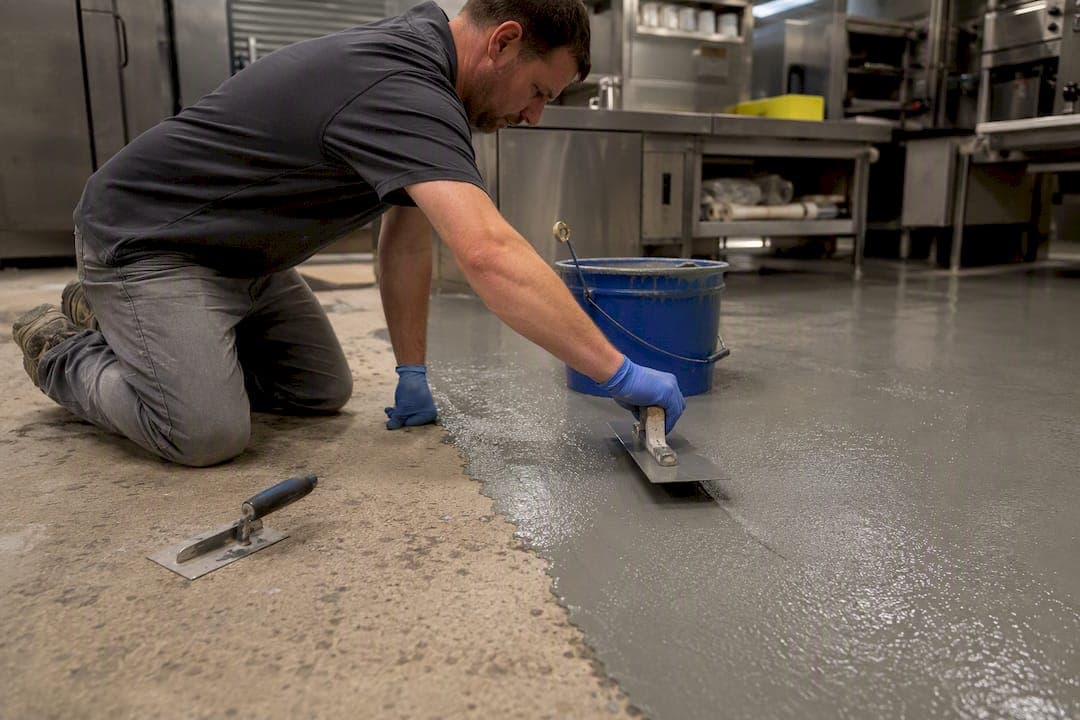
Cook lines hold up best under cementitious urethane or a heavy-grade epoxy mortar rated for thermal shock; dish pits need a seamless urethane or epoxy system; dry prep areas do fine with sealed vinyl or standard epoxy; front-of-house handles porcelain or LVT; and anywhere staff stand for hours benefits from rubber anti-fatigue matting. Before signing any contract, make the installer prove two things on paper: a wet DCOF rating of 0.55 or higher for back-of-house zones, and NSF/ANSI 51 certification for the full floor system, not just the coating. Confirm the bid includes an integral cove base and correct slope-to-drain, and ask whether the crew plans to diamond-grind the substrate before anything gets poured.
- Cook line: cementitious urethane or epoxy mortar (thermal shock resistant)
- Dish pit: seamless urethane or epoxy system
- Prep area: sealed vinyl or standard epoxy
- Front of house: porcelain tile or LVT
- Standing zones: rubber anti-fatigue matting
Pro Tip: Ask any bidder for their DCOF wet-test documentation before you ask about price. A contractor who can't produce it usually hasn't tested the product they're proposing to install on your floor.
Key Takeaways
Commercial kitchen flooring succeeds when the material matches the zone's heat and grease load, the system carries verified DCOF and NSF/ANSI 51 documentation, and the substrate gets diamond ground before installation.
| Point | Details |
|---|---|
| Match material to zone | Use cementitious urethane or epoxy mortar on cook lines, seamless systems in dish pits, and vinyl or porcelain elsewhere. |
| Verify DCOF and NSF ratings | Require wet DCOF of 0.55 to 0.65 for back-of-house and NSF/ANSI 51 system certification before signing. |
| Insist on cove base and slope | Integral cove bases and 1/8 to 1/4 inch per foot slope-to-drain prevent food and moisture buildup. |
| Demand diamond grinding and MVER testing | Skipping substrate prep and moisture testing is the leading cause of delamination and early failure. |
| Work with Showmeepoxy for commercial installs | Showmeepoxy applies diamond-grinding prep on every commercial job and offers a free cost calculator for budgeting. |
Table of Contents
- What Specs Make Commercial Kitchen Flooring Code-Compliant?
- Which Flooring Material Actually Holds Up in a Commercial Kitchen?
- How Do You Choose Flooring by Kitchen Zone?
- What Installation Steps Prevent Floor Failure?
- How Much Maintenance Does Commercial Kitchen Flooring Need?
- Why Do Commercial Kitchen Floors Crack, Peel, or Fail Early?
- Are Some Commercial Kitchen Flooring Materials More Sustainable Than Others?
- What Does Commercial Kitchen Flooring Really Cost Over Time?
- Sources
What Specs Make Commercial Kitchen Flooring Code-Compliant?
Health inspectors and insurance adjusters both care about the same measurable numbers, so start there. ANSI A137.1 sets a DCOF wet minimum of 0.42 for any interior surface that could get wet, but that's a floor, not a target. Grease cuts traction faster than water does, which is why back-of-house zones should specify 0.55 to 0.65 for a real safety margin under fryer splatter and dishwasher steam.
- NSF/ANSI 51 certification covers the whole assembled floor system, not just the topcoat, so ask your contractor which components in their proposal actually carry that certification.
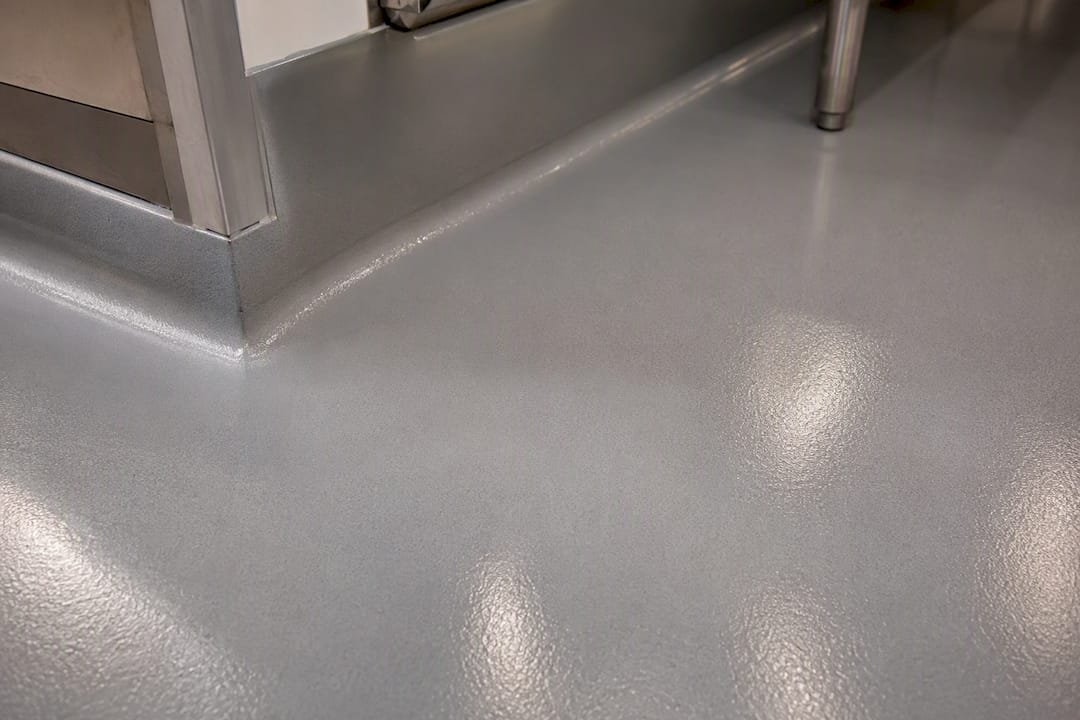
- Integral cove base and slope-to-drain are the two elements health departments look for as a system, since square corners trap food debris and flat floors pool grease and water.
- Drain placement should sit within about 15 feet of major cooking equipment, with a slope of 1/8 to 1/4 inch per foot to keep water moving instead of standing.
- Surface texture from broadcast aggregate improves grip but also traps soil, so match texture aggressiveness to how often the zone actually gets scrubbed.
- Grout selection matters more than most managers realize: cement grout absorbs grease and breaks down under repeated degreasing, so epoxy grout is the standard for any tiled back-of-house floor, or skip grout lines entirely with a seamless poured system.
Which Flooring Material Actually Holds Up in a Commercial Kitchen?
Every material on this list works somewhere in a commercial kitchen. None of them work everywhere, and picking the wrong one for the wrong zone is the single most common reason floors fail early.
Quarry tile has been the default back-of-house choice for decades because its natural texture resists slipping even when the surface is wet and greasy. The tradeoff is grout: cement-based grout degrades fast under grease exposure, so specify epoxy grout from the start or plan on regrouting within a few years. Service life for quarry tile can be long with proper grout, typically considered moderate in installed cost per square foot.
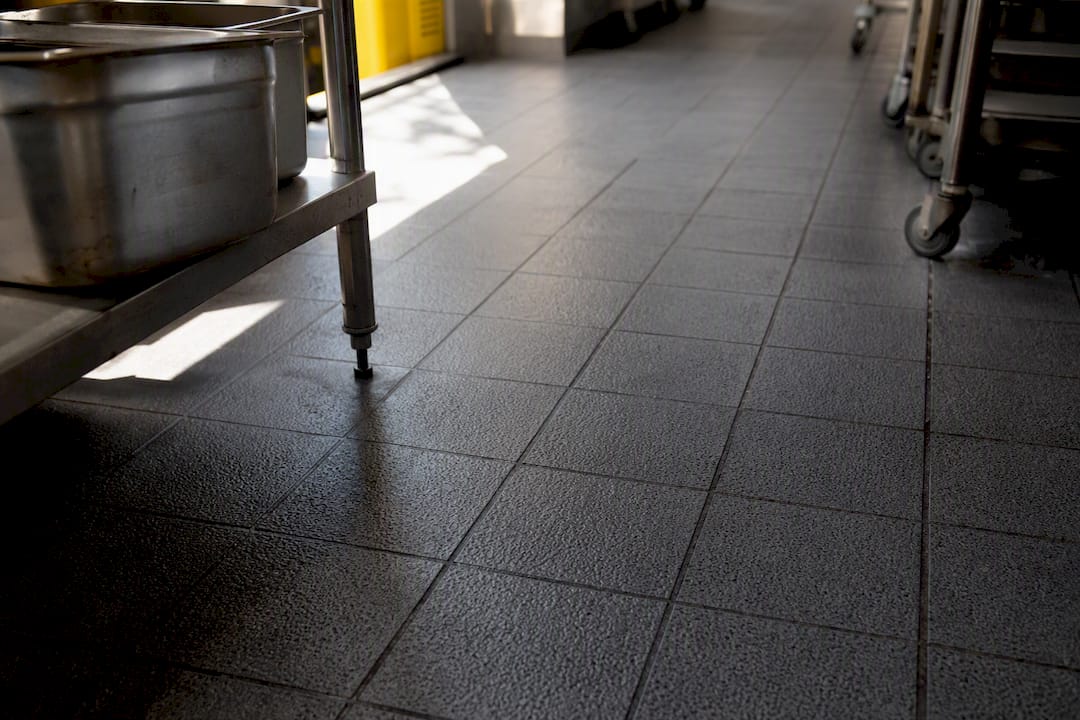
Porcelain and through-body textured tile give you far more aesthetic flexibility, especially for dining rooms that want a kitchen-adjacent look. Specify a tile rated R12 or R13, or confirm a DCOF of 0.55 or above, and pair it with epoxy grout in any zone that sees grease.
Commercial vinyl, including sheet vinyl and LVT, works well in light-prep areas and front-of-house zones where heat and standing water are rare. The seams are the weak point: near a steam kettle or a heavy-boil station, repeated moisture cycling works its way under the seams and lifts them within a year or two. Save vinyl for dry, lower-traffic zones.
Coated or polished concrete can be acceptable in walk-in coolers or dry storage, but raw concrete is porous and will absorb grease and bacteria without a sealer. Polishing alone doesn't solve porosity. Treat concrete as a substrate to be coated, not a finished kitchen floor.
Epoxy systems split into two very different products. Standard broadcast epoxy is budget-friendly and works fine in dry prep areas, walk-in coolers, and service corridors, but it's prone to cracking or delaminating under thermal shock and heavy grease exposure. Epoxy mortar, a heavier trowel-applied system, resists impact and thermal cycling far better and holds up under rolling carts and dropped pans.
Cementitious urethane, also called urethane cement, is seamless, resists thermal shock, and can be poured with an integral cove base built right in. It's the system most commercial kitchen designers now spec for busy cook lines because it shrugs off boiling water spills and steam-table heat that would crack a standard epoxy topcoat. Expect a higher installed cost than epoxy, offset by a longer service life on the hardest-working part of the kitchen.
Rubber flooring earns its keep as anti-fatigue matting at prep stations and dish stations rather than as a primary floor. Grease and direct heat exposure degrade rubber faster than other materials, so treat it as a targeted comfort layer, not a cook-line spec.
Pro Tip: Never let a bidder quote "epoxy" as a single line item. Ask whether they mean broadcast epoxy, epoxy mortar, or a urethane hybrid; the price and performance gap between those three is enormous.
How Do You Choose Flooring by Kitchen Zone?
Match the system to how much heat, grease, and moisture the zone actually sees, then check cure time against how long you can afford to shut that area down.
- Cook line: cementitious urethane or epoxy mortar. Boiling water spills and steam-table heat are constant, and only these two systems shrug off repeated thermal cycling.
- Dish pit: seamless urethane or heavy epoxy. Standing water and detergent exposure all day punish anything with seams or grout lines.
- Prep area: sealed vinyl or standard epoxy, depending on how much heat migrates in from the cook line next door.
- Walk-ins and coolers: coated concrete or epoxy, chosen mainly for moisture resistance and easy sanitizing.
- Front of house: porcelain tile or LVT, prioritizing looks and comfort over industrial-grade chemical resistance.
If your kitchen can't close for more than a weekend, a rapid-cure polyaspartic system may cost more upfront but gets you back in service fast; it still demands the same surface prep and documentation as any other system, so don't let speed replace diligence. Before awarding any bid, demand DCOF wet-test results, proof of NSF system certification, and moisture vapor emission rate (MVER) records for the slab. Walk away from any proposal that skips MVER testing, describes substrate prep vaguely, or leans on hobby-grade coating products marketed for garages.
Pro Tip: If two bids quote wildly different prices for what looks like the same system, the gap is almost always in surface prep, not materials. Ask both contractors to itemize grinding, patching, and moisture testing separately.
What Installation Steps Prevent Floor Failure?
Diamond grinding removes laitance and opens the concrete's pore structure, creating the mechanical profile epoxy and urethane systems need for a permanent bond. Any scope of work that just says "surface prep" without naming grinding, patching, and profile requirements is a red flag.
- Confirm the contract specifies diamond grinding to a defined surface profile, not just "cleaning" or "etching."
- Require moisture vapor emission rate (MVER) testing before installation; skipping it is a leading cause of delamination months after a job looks finished.
- Ask for cure and return-to-service windows in writing: epoxy mortar and urethane cement typically need 24 to 72 hours before light traffic, while rapid-cure polyaspartic systems can often reopen within a day.
- Verify drain and trench locations get built into the pour, with cove bases poured integrally rather than caulked in afterward.
- Demand a written warranty that names the surface prep method used; for expert application details and guarantees, see Garage Floor Epoxy Coating Houston, TX | SpudMetrix. Vague warranties that don't mention grinding or MVER testing rarely hold up if the floor fails.
How Much Maintenance Does Commercial Kitchen Flooring Need?
Daily upkeep is what actually determines whether a floor hits its expected lifespan or fails five years early. Squeegee grease and water toward the drain at the end of every shift, and run a weekly rotary scrub with an alkaline degreaser to break down buildup that daily mopping misses. Skip high-pressure washing on tiled floors; it drives water into grout lines and accelerates the exact degradation epoxy grout is supposed to prevent. Schedule an annual walkthrough to check coves and drains for gaps, since that's where sanitation failures usually start.
Lifespans vary sharply by system. Quarry tile with proper epoxy grout can run 20 to 30 years. Cementitious urethane typically lasts 15 to 20 years on a busy cook line. Standard epoxy mortar runs closer to 10 to 15 years, shorter if thermal shock or heavy carts are a daily occurrence. Urethane systems generally need a recoat every 12 to 18 months in heavy-use kitchens to maintain slip resistance and seal any micro-cracking before it spreads.
| Material | Typical Lifespan | Installed Cost Range (per sq ft) |
|---|---|---|
| Quarry tile (epoxy grout) | 20 to 30 years | Moderate |
| Cementitious urethane | 15 to 20 years | Higher |
| Epoxy mortar | 10 to 15 years | Moderate |
| Standard broadcast epoxy | 5 to 10 years | Lower |
Site conditions, especially drain relocation or extensive slab repair, can push any of these ranges higher, so treat quotes as starting points rather than final numbers.
Why Do Commercial Kitchen Floors Crack, Peel, or Fail Early?
Most flooring failures trace back to one of three causes: skipped substrate prep, wrong material for the zone, or ignored moisture. Cracking in epoxy or urethane floors almost always starts at a control joint that wasn't cut or at a spot where the substrate wasn't ground before the coating went down. If you see hairline cracks spreading from a corner or a seam, that's usually a prep failure, not a product failure.
Peeling and delamination show up when moisture vapor pushes up from below an uncured or untested slab. This is exactly what MVER testing catches before installation, and it's why skipping that test is such an expensive mistake. Once a coating delaminates, patching rarely holds; the entire section usually needs to be ground out and reinstalled.
Water damage tends to appear at cove bases and around drains first, since those are the transition points where a floor system is most likely to have a gap. If you notice staining or soft spots creeping outward from a drain, check whether the cove base was poured integrally or caulked on afterward. Caulked coves fail faster because the seal is only as good as the caulk's adhesion, and grease exposure breaks that bond over time.
Standing water anywhere on the floor points to a slope problem, not a cleaning problem. No amount of squeegeeing fixes a floor that was poured flat. If a section consistently puddles, that area likely needs to be reground and repoured with correct slope-to-drain, ideally during a broader recoat cycle rather than as an emergency patch.
Are Some Commercial Kitchen Flooring Materials More Sustainable Than Others?
Lifespan is the biggest sustainability lever a facilities manager actually controls. A floor that lasts 20 years and only needs a recoat every 12 to 18 months generates far less waste over time than a cheaper system that needs full replacement every five to seven years, even before you factor in the labor, downtime, and demolition debris that comes with each replacement.
Material choice matters too. Quarry tile is a fired clay product with a long service life and no ongoing chemical recoating, which keeps its environmental footprint relatively low once installed. Epoxy and urethane systems involve resins and hardeners that carry more upfront manufacturing impact, but their durability and recoat cycle (rather than full tear-out) can offset that over a floor's working life.
Water use during maintenance is another factor worth weighing. Seamless epoxy and urethane floors clean with less water than tile, since there are no grout lines to scrub and no risk of driving water into a porous joint. That translates into lower water and chemical use across years of daily degreasing and weekly scrubbing.
Diamond grinding itself has a sustainability angle that's easy to overlook: it lets an existing concrete slab become the finished substrate instead of requiring new material to be poured or shipped in. Reusing the slab you already have, rather than tearing it out, cuts both material use and construction waste. When you're comparing bids, ask whether the contractor's prep process is designed to work with your existing slab or replace it, since that decision affects both your budget and your footprint.
What Does Commercial Kitchen Flooring Really Cost Over Time?
The sticker price on a flooring bid is the smallest number you'll deal with over the life of that floor. Installation cost matters, but maintenance frequency and eventual replacement or recoating usually add up to more than the original install, especially on systems that were undersized for their zone.
A standard broadcast epoxy floor might look like the cheapest option on a cook line, but if it delaminates in year six because it couldn't handle thermal shock, you're paying for a full tear-out and reinstall, plus the kitchen downtime that comes with it. Cementitious urethane costs more upfront but stretches maintenance-driven downtime out to a recoat every 12 to 18 months rather than a full replacement every five to ten years.
Total cost of ownership breaks into four buckets: installation, routine maintenance (degreasers, rotary scrubbing supplies, labor), periodic recoating, and eventual replacement. A quarry tile floor with epoxy grout has low recoat costs but higher labor time for daily grout care. A urethane cook-line floor has higher installation cost but lower long-term labor since there's no grout to maintain and fewer emergency repairs from thermal cracking.
The zone matters as much as the material when you're running these numbers. Spending extra on urethane for a cook line that runs boiling pots for ten hours a day pays for itself in avoided downtime. Spending the same premium on a dry storage room that never sees heat or heavy traffic is money that could have gone toward a standard epoxy system instead, with the difference banked for the zones that actually need it.
Field Notes on Substrate Prep and Cure Time
Most flooring calls Showmeepoxy gets after a failure trace back to the same root cause: someone skipped the grinding step to save a day or two on the schedule. A slab that looks clean isn't the same as a slab with an open pore structure, and that gap is where delamination starts. On tight timelines, we've found the honest conversation is upfront: a rapid-cure polyaspartic gets you back in service faster, but it still needs the same ground substrate a slower urethane cement system does. Cutting corners on prep to save a day now usually costs a full week of downtime later.
— Stephen
Get a Commercial Kitchen Floor Built Right the First Time
Showmeepoxy installs commercial-grade epoxy and polyaspartic floor systems for kitchens across Mid-Missouri, and the diamond-grinding prep described throughout this guide is standard on every job, not an upsell. That's the practical difference for a facilities manager comparing bids: a contractor who grinds the substrate before pouring anything gives you a bonded floor system built to hold up, not just a coating that looks good on installation day.

Commercial jobs move on real timelines, so we scope substrate condition, drain locations, and cure-time needs before quoting anything. If you're planning a kitchen renovation or replacing a failing floor, start with the commercial epoxy flooring page to see the scope of work we handle, or run your project through the free cost calculator for a preliminary budget number before you request a formal quote through our contact page.
Sources
- Industrial Kitchen Flooring: Pros, Cons, and Buying Guide - D and G Flooring
- Flooring requirements for commercial kitchens, cafeterias & dining spaces - RJ, Inc.
- What is the Best Flooring for a Restaurant Kitchen? | Feature Flooring