
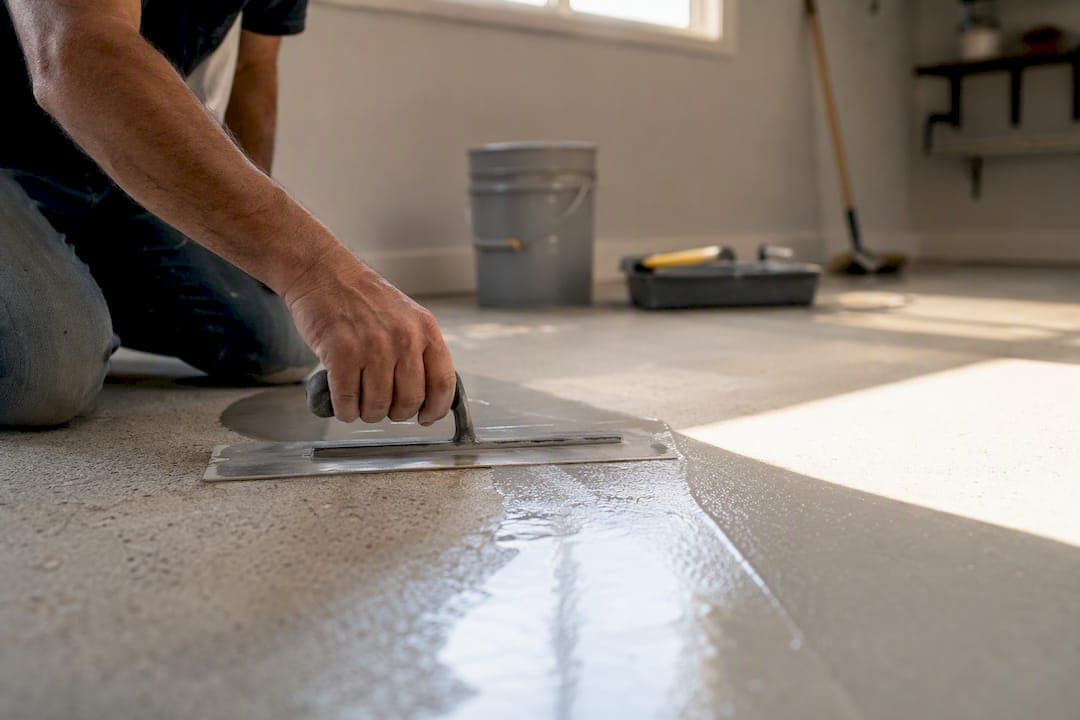
For garages and chemical-exposed workspaces, epoxy usually wins. For architectural interiors and low-maintenance open-plan spaces, polished concrete usually wins. But that rule only holds if your slab passes moisture testing first. A slab with elevated moisture or no vapor barrier can override every other preference on this list, pushing you toward polishing or moisture remediation before any coating goes down.
Here's the short version:
- Epoxy: better chemical and stain resistance, more color and texture options, ideal for garages, workshops, and food-service floors.
- Polished concrete: harder wearing surface, no film to delaminate, better fit for showrooms and living areas.
- The deciding gate: moisture testing, not personal taste, often makes the final call.
Showmeepoxy has installed enough garage and basement floors around Mid-Missouri to know that the "which is better" question usually isn't the right one. The right question is whether your slab qualifies for a coating at all.
Key Takeaways
The right floor depends less on style preference than on whether your slab passes moisture testing and how much chemical exposure the space will see.
| Point | Details |
|---|---|
| Verdict by use case | Epoxy usually fits garages and chemical-exposed spaces; polished concrete usually fits architectural interiors. |
| Moisture testing decides a lot | ASTM F1869 and ASTM F2170 results can override style preference and push you toward polishing instead. |
| Lifecycle costs diverge | Epoxy typically needs a recoat every five to seven years; polished concrete needs periodic densifier upkeep instead. |
| Prep determines success | Diamond grinding to the right CSP profile prevents the blistering and delamination that acid etching often causes. |
| Showmeepoxy's approach | Showmeepoxy uses diamond-grind prep and industrial-grade materials, and offers free quotes with moisture testing included. |
Table of Contents
- Epoxy vs Polished Concrete: What's the Real Difference?
- Which Floor Handles Daily Wear Better?
- Which Costs Less Over Time: Epoxy or Polished Concrete?
- Which Looks Better: Epoxy or Polished Concrete?
- What Does Proper Installation Actually Require?
- Which Rooms Should Get Epoxy, and Which Should Get Polished Concrete?
- What Should You Ask Before Hiring an Installer?
- What I'd Tell a Homeowner Deciding Between the Two
- Get a Straight Answer on Your Own Floor
- Frequently Asked Questions
- Sources
Epoxy vs Polished Concrete: What's the Real Difference?
Epoxy is a resin film bonded to the top of a prepared slab. Polished concrete is the slab itself, mechanically ground and chemically densified until it becomes its own finished surface. That distinction shapes everything else in this comparison.
Because epoxy sits on top of the concrete, it can hide cracks, discoloration, and old stains that polishing would only expose. It also opens the door to color, pattern, and texture that raw concrete can't offer. Polished concrete goes the other direction: it reveals the slab's natural character, which means a rough or badly poured floor will show every flaw, but there's no film to peel, bubble, or delaminate later.
That structural gap is also why moisture testing matters so much more for coatings. The polished concrete vs. concrete coatings decision framework treats moisture as the first checkpoint, using standardized tests like ASTM F1869 (calcium chloride moisture vapor emission) and ASTM F2170 (in-slab relative humidity probes). Polished concrete has no equivalent gate. It simply is the slab, moisture and all.
Which Floor Handles Daily Wear Better?
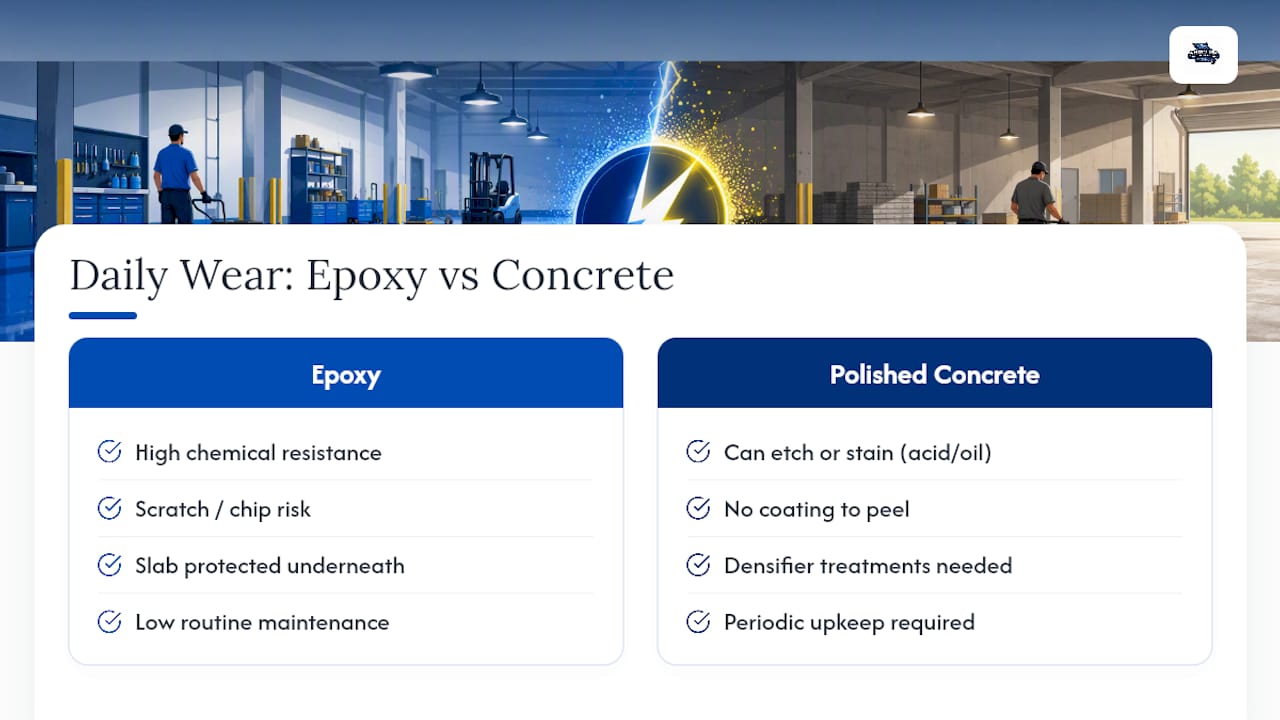
Both surfaces are tough, but they fail in different ways. Epoxy is non-porous, which makes it highly resistant to motor oil, brake fluid, salt, and most household chemicals. Spills wipe up instead of soaking in. That non-porous surface is also why epoxy is the practical winner for garages and utility spaces, where hot tires, dropped tools, and chemical exposure are routine. The tradeoff: a sharp impact can scratch or chip the coating, though the slab underneath stays protected.
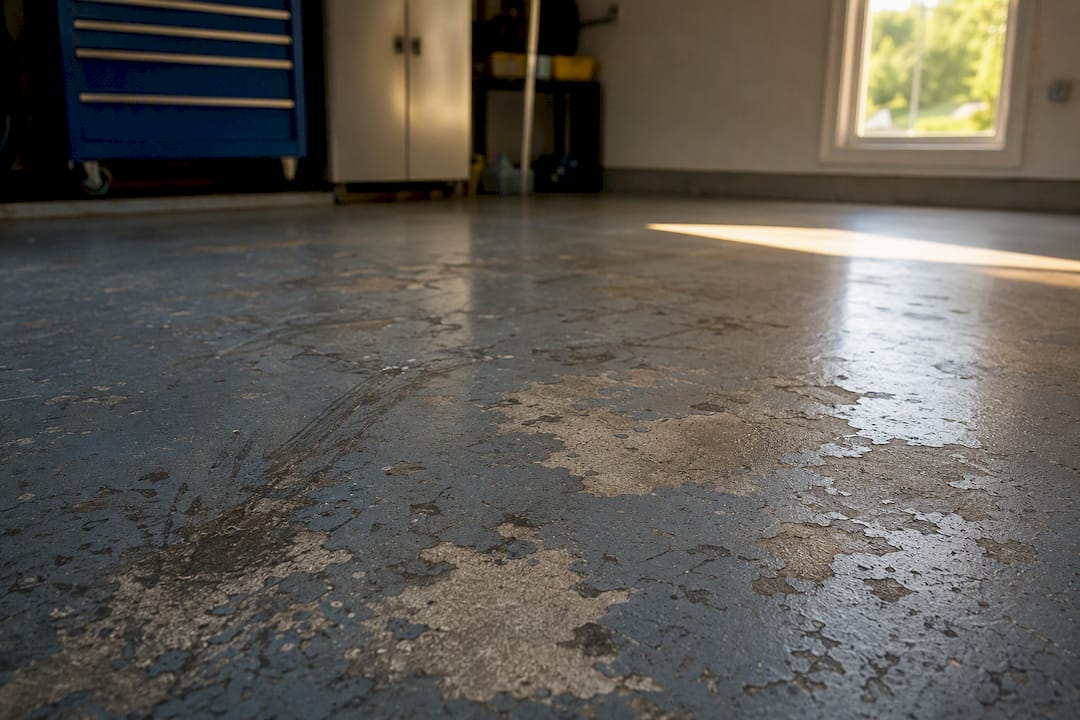
Polished concrete has no coating to damage, so there's nothing to peel or blister. Its weak points are different. Acidic spills, like vinegar or citrus juice, can etch the surface, and oil left sitting too long can stain the concrete itself since there's no film blocking it. Densifier treatments help, but they're a maintenance task, not a one-time fix.
Slip resistance is where installers earn their keep on both sides. High-gloss finishes on either surface can get slippery when wet, so most professionals reference ANSI A326.3 dynamic coefficient of friction (DCOF) guidance and add traction, whether that's aluminum oxide grit blended into epoxy or a lower-gloss polish level for concrete.
Pro Tip: If a garage floor needs to handle wet tires in winter, ask your installer to blend in a slip-resistant additive at the topcoat stage rather than relying on gloss level alone.
Which Costs Less Over Time: Epoxy or Polished Concrete?
Upfront pricing for basic epoxy and basic polished concrete tends to land in overlapping ranges, according to industry cost comparisons. Decorative epoxy systems (flake, metallic, thick-mil builds) push the price higher, and high-gloss, multi-step polished concrete does the same on the other side.
The real cost story shows up years later. Epoxy coatings typically need periodic recoating every few years, depending on traffic and topcoat chemistry, while polished concrete generally only needs periodic densifier maintenance rather than a full redo. A recoat is usually a fraction of the original installation cost. A re-grind of polished concrete, by contrast, is a bigger, less frequent event.
- Entry-level epoxy: lower cost, shorter recoat cycle, and faster turnaround.
- Decorative epoxy (flake, metallic): higher upfront cost, same recoat cycle.
- Basic polished concrete: moderate cost, infrequent maintenance.
- High-gloss polished concrete: higher labor cost, still low recurring maintenance.
If you're weighing garage-specific numbers, Show Me Epoxy's breakdown of epoxy garage floor lifespan covers what actually shortens or extends that recoat window.
Which Looks Better: Epoxy or Polished Concrete?
Epoxy wins on sheer variety. You can choose solid color, decorative flake blends, metallic swirls, or quartz broadcast systems, and dial the finish from matte to high gloss. That range is part of why epoxy shows up so often in garages and workshops, where owners want both durability and a specific look.
Polished concrete works with a narrower, more architectural palette: aggregate exposure, integral or topical stains and dyes, and control over gloss level through the grinding sequence. It's a restrained look on purpose, and it ages differently. Epoxy holds its color and sheen well until the topcoat wears thin near a recoat cycle. Polished concrete's appearance depends more on consistent densifier maintenance than any coating schedule.
For a deeper look at how finish choice affects both looks and durability, see Show Me Epoxy's guide to epoxy floor finishes.
What Does Proper Installation Actually Require?
This is where most flooring disappointments start, and it has almost nothing to do with the finish you picked.
- Moisture testing first. ASTM F1869 measures moisture vapor emission rate; ASTM F2170 measures in-slab relative humidity with embedded probes. Slabs that fail these tests are prone to blistering and delamination once coated, and remediation or polishing becomes the safer route.
- Surface profile matters. The ICRI (International Concrete Repair Institute) publishes CSP, or concrete surface profile, standards that define how rough the slab needs to be for a coating to mechanically key into it. Diamond grinding creates that profile reliably; acid etching often does not.
- Watch for shortcuts. A quote with no mention of moisture testing, a plan to acid-etch instead of grind, or no written warranty are all signs the installer is skipping steps that show up later as bubbling or peeling.
Grinding concrete before epoxy isn't a preference; it's the mechanical basis for adhesion.
Pro Tip: Ask every epoxy quote for the actual moisture test numbers, not just a verbal "it should be fine." A legitimate installer will have them in writing before they schedule your install date.
Which Rooms Should Get Epoxy, and Which Should Get Polished Concrete?
Match the floor to how the room actually gets used, not just how it should look.
- Garages, workshops, and food-service back-of-house: epoxy, for chemical resistance and easy cleanup.
- Showrooms, offices, and open-concept living areas: polished concrete, for a lower-maintenance architectural look.
- Retail and light industrial floors: either works, but epoxy adds color-coded zoning options that plain polished concrete can't.
- Basements: prefer polishing, or address moisture issues before coating. A slab below grade is exactly where the moisture gate matters most, and polyaspartic coatings offer a faster-cure alternative when a coating is still the right call.
If you're still deciding whether a coating pencils out at all, Showmeepoxy's piece on epoxy's return on investment walks through the numbers room by room.
What Should You Ask Before Hiring an Installer?
A good quote reads like a technical document, not a sales pitch. Request the moisture test results, the target CSP number, the grinding method (not just "surface prep"), the specific primer and topcoat chemistry, and the warranty terms in writing.
Diamond-grind preparation is Showmeepoxy's standard practice for exactly this reason: it creates the mechanical profile a coating needs to bond permanently instead of failing at year two. Skipping it to save a day on the schedule is one of the most common causes of the bubbling and peeling homeowners complain about.
A permanent bond starts with the surface prep, not the topcoat. Grinding the slab to the right profile is what keeps an epoxy floor from failing in year two instead of year twelve.
Before hiring anyone, it's also worth checking BBB accreditation and complaint history for any installer you're considering, epoxy or polished concrete alike.
What I'd Tell a Homeowner Deciding Between the Two
Most people research this decision backward. They pick a look on Pinterest, then hire someone to make their slab match it. Flip that order. Test the slab first, then choose the finish that fits what the concrete will actually allow.
The moisture gate gets treated as a footnote in a lot of flooring advice, and that's the biggest gap I see between what gets written and what actually happens on job sites. A slab that fails ASTM F2170 doesn't care how much you love a metallic flake pattern. It's going to blister the coating regardless.
The second most overrated factor is upfront price. Homeowners fixate on the installation quote and skip the recoat math entirely. A five to seven year recoat cycle is fine to plan around. It's a bad surprise if nobody mentioned it upfront.
If there's one thing worth prioritizing over aesthetics, it's asking your installer exactly how they're preparing the surface. Diamond grinding versus acid etching is the difference between a floor that lasts and one that doesn't.
Get a Straight Answer on Your Own Floor
You don't have to guess whether your garage or basement slab qualifies for epoxy. Showmeepoxy tests for it, using diamond-grind preparation and industrial-grade materials built to handle real Missouri temperature swings and moisture conditions, instead of shortcuts that show up as bubbling two years later.

A free consultation with Showmeepoxy includes moisture testing, a surface profile assessment, a realistic timeline, and a straightforward cost estimate, no pressure, no upsell script. If you want a ballpark before you even schedule a visit, run your project through the free epoxy flooring cost calculator first. When you're ready to talk specifics, request your quote at Showmeepoxy and find out whether your slab is a coating candidate or needs prep work first.
Frequently Asked Questions
Is epoxy or polished concrete cheaper? Basic versions of both typically fall in overlapping price ranges upfront. The bigger cost difference shows up over time: epoxy usually needs a recoat every five to seven years, while polished concrete needs only occasional densifier treatments.
Can you put epoxy over polished concrete? Technically yes, but it defeats the point. Polished concrete is designed to be the finished surface, and coating over it means grinding away work you already paid for to create the surface profile epoxy needs to bond.
Does polished concrete crack more than epoxy floors? Polished concrete can reveal existing slab cracks since there's no film covering them. Epoxy can bridge minor surface imperfections, though it won't fix structural cracking underneath.
Is epoxy or polished concrete better for a basement? Polished concrete or moisture remediation is usually the safer route for basements, since below-grade slabs are more likely to carry elevated moisture that can cause coating failure. A polyaspartic coating can work as a faster-curing alternative once moisture issues are resolved.
How long does polished concrete last compared to epoxy? Polished concrete can last decades with periodic densifier maintenance and no recoat requirement. Epoxy coatings last well too, but typically need recoating every five to seven years depending on traffic and topcoat quality.
Sources
- Polished concrete vs concrete coatings: 2026 decision guide
- Epoxy vs. Polished Concrete (2026) | Ascent Epoxy