
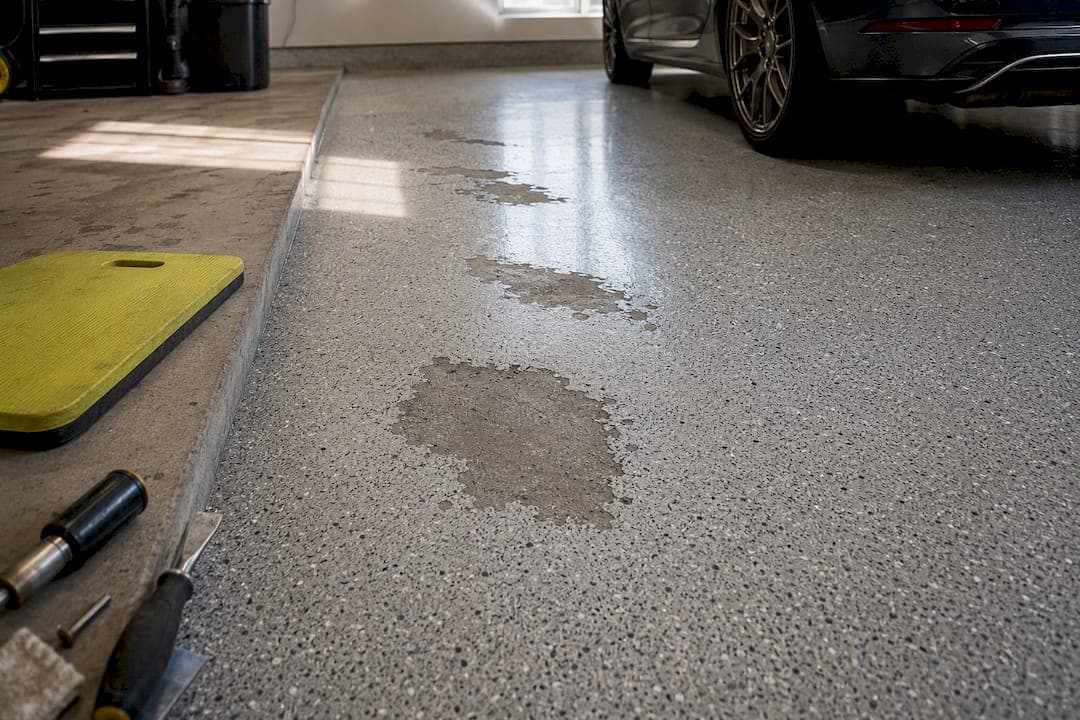
Hot tire pickup is what happens when a warm tire cools and contracts on a driveway or garage coating, pulling the surface material up with it in soft, torn patches. It's an adhesion failure, not the tire melting the finish, and the fix depends on catching it early.
If you're staring at a fresh tear right now, stop parking on that spot immediately. Lay down a towel, cardboard, or a rubber tire mat over the area, and snap a few photos while the damage is fresh. That documentation matters more than most homeowners realize; a contractor quoting a repair sight unseen is guessing.
The single most effective long-term fix is proper substrate preparation, specifically diamond grinding, paired with a coating rated for high heat tolerance. Everything else, including mats, parking rotation, and touch-up kits, buys time. It doesn't solve the underlying bond problem.
- Stop parking on the affected spot and protect it with a mat or pad
- Photograph the lifted area now, before it spreads or gets driven over again
- Plan for diamond-ground prep and a high-heat coating system as the permanent fix
- Call a pro if the lift covers more than a small patch or keeps coming back
Pro Tip: If you can slide a coin edge under the lifted material without resistance, you're looking at true adhesion failure, not just a surface scuff. That's your cue to stop DIY patching and call in a professional assessment.
Key Takeaways
Hot tire pickup is an adhesion failure driven by heat, contraction, and suction, and the only permanent fix is diamond-ground prep paired with a high-Tg coating system.
| Point | Details |
|---|---|
| Diagnose before you patch | Use the coin-edge dent test to confirm true adhesion failure rather than surface scuffing. |
| Prep beats product | Diamond grinding creates the mechanical bond that thick coatings alone can't replace. |
| Match coating to climate | Choose polyaspartic or high-Tg systems, and add vapor primer in humid regions. |
| Mitigate while you plan | Use mats, rotate parking, and let tires cool before pulling into the garage. |
| Escalate repeated failures | Recurring lift in the same spot means the original prep was inadequate, not the coating. |
Ready to stop patching and fix the root cause? Get a project estimate with Showmeepoxy's free cost calculator or reach out through Showmeepoxy to talk through a diamond-ground, heat-resistant install built for how you actually use your garage.
Table of Contents
- What Causes Hot Tire Pickup?
- Which Surfaces and Coatings Are Most Vulnerable?
- How Do You Repair Hot Tire Pickup?
- How Can You Prevent Hot Tire Pickup?
- When Should You Call a Professional?
- How Professional Installation Prevents Pickup for Good
- What the Research Actually Tells Us About Fixing This Problem
- Frequently Asked Questions
- Sources
What Causes Hot Tire Pickup?
A tire that's been driven for even 10 or 15 minutes on a hot day can carry a lot of stored heat and pressure into your driveway or garage. That heat transfers into the coating right at the contact patch, and the tire's weight presses the softened material down. As the tire cools, it contracts, and on a smooth, high-gloss film, that contraction creates a genuine vacuum effect that grabs the coating and lifts it clean off the slab.
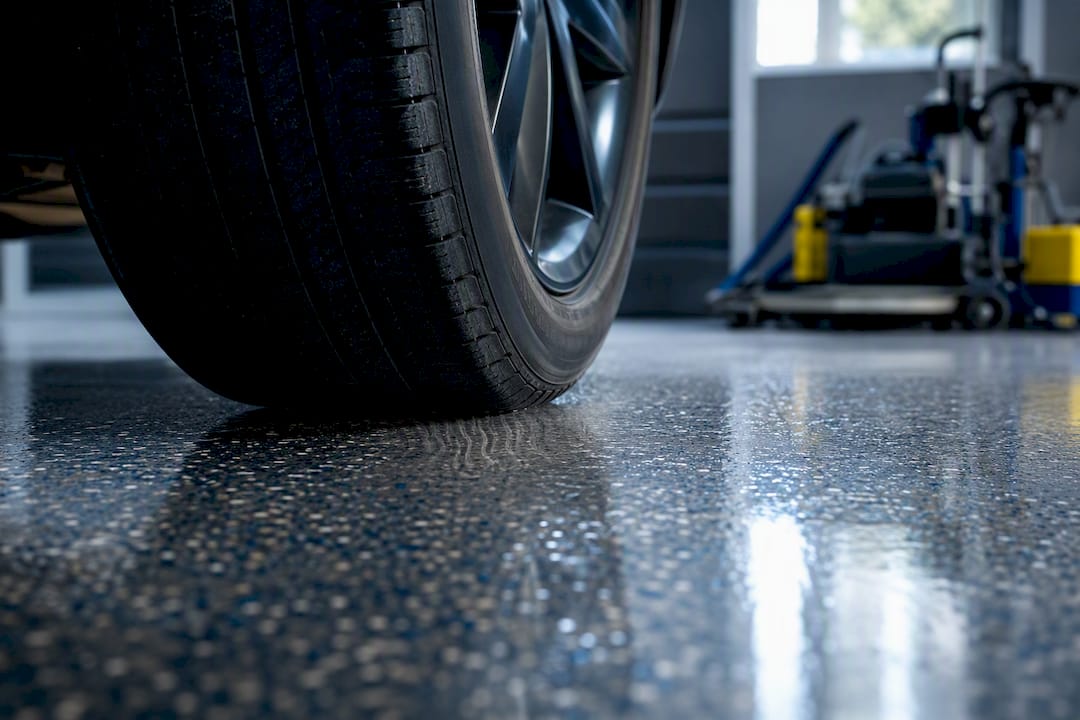
Adhesion is really the whole story here. Hot tire pickup happens because the bond between the coating and the concrete was never strong enough to resist that pull, according to Concrete Decor's breakdown of stamped concrete failures. It's rarely the tire literally melting anything.
Modern tires complicate matters further. Softer rubber compounds shed plasticizers, oily compounds that migrate into a coating on contact and chemically soften it from within. Combine that with a coating that hasn't fully cured, or one with a low glass transition temperature (the point where a polymer shifts from rigid to soft), and you've got a recipe for failure. Tire surface temperatures commonly climb near or above 140°F after driving in hot weather, which is enough to push weaker chemistries past their limit.
- Heat and weight from the tire soften the coating at the contact point
- Cooling and contraction create suction on smooth, glossy films
- Plasticizers from tire rubber migrate into the coating and weaken it further
- Undercured or low-Tg coatings are far more vulnerable than fully cross-linked ones
You can run a quick check at home: press a coin edge into the lifted area. If it dents easily or feels tacky rather than brittle, you're dealing with soft, undercured material or true adhesion failure, according to diagnostic guidance from Iron Eagle Coatings.
Which Surfaces and Coatings Are Most Vulnerable?
Not every surface fails the same way, and the fix looks different depending on what's under your tires.
- Bare or acrylic-sealed concrete and stamped concrete. Thin acrylic sealers are the most common victims because they rely on surface-level bonding rather than a true chemical cross-link. Cross-linked chemistries anchor into the slab instead of just sitting on top, which is why "thin to win" (thin, well-bonded coats) beats a thick, poorly adhered one every time.
- Asphalt driveways. Surface sealers on asphalt have real limits and can't fully solve pickup on their own; if the asphalt itself is degraded, replacement or a different surface treatment is often the more honest answer.
- DIY epoxy garage kits. Big-box kits use low-solids formulas and skip mechanical prep entirely, which explains why they peel under tires far more often than professionally installed systems, a pattern well documented by GarageFlooringLLC's research on resistant flooring options.
- Polyaspartic and high-Tg systems. These resist heat softening and plasticizer attack far better than acrylics or thin epoxies, which is why professional installers layer them as topcoats.
- Texture matters everywhere. A perfectly smooth, glossy finish maximizes the vacuum effect when a tire cools. Adding anti-slip aggregate or micro-texture breaks up that contact area and cuts suction risk.
How Do You Repair Hot Tire Pickup?
Your repair path depends entirely on how bad the damage is. Small, isolated pulls call for a spot fix. Widespread lifting means the whole system needs attention.
- Stop the bleeding first. Keep vehicles off the area, cover it, and photograph every affected spot before you touch anything.
- Spot repair for small pulls. Clean the area thoroughly, mechanically abrade the exposed concrete, apply a compatible primer, and recoat with a matching topcoat.
- Full remediation for extensive damage. This means stripping the failed coating entirely, diamond grinding the slab to create a fresh mechanical profile, running a moisture test, applying a vapor-barrier primer if needed, then laying a proper base coat and a high-Tg topcoat.
- Budget accordingly. Cost and timeline scale with how much grinding and moisture mitigation the slab needs, not just the square footage. A garage with high moisture vapor pressure typically needs a vapor primer step that adds both time and expense, a common requirement noted in humid-climate installs by Apex Flooring.
Pro Tip: If your coating has failed more than once in the same spot after a spot repair, that's a sign the original prep was inadequate. Patching the same weak bond a second time rarely holds; that floor needs to be stripped and reground.
DIY spot repairs work fine for a few small blemishes. Anything covering a significant portion of a garage bay or driveway lane is a job for a crew with grinding equipment and moisture meters, not a touch-up bottle from the hardware store. For a sense of how long a properly installed system should last before you're dealing with this at all, see how epoxy garage floor lifespan is typically calculated.
How Can You Prevent Hot Tire Pickup?
Prevention starts before a single drop of coating hits the floor, and it continues in how you use the space afterward.
- Demand mechanical prep. Diamond grinding, thorough cleaning, crack repair, and a moisture test should be non-negotiable steps any installer performs before coating goes down.
- Choose the right chemistry. Highly cross-linked systems with a high glass transition temperature outperform basic acrylics, especially in a garage that sees daily hot-tire traffic.
- Apply thin, correctly cured coats. Thicker isn't better here; a well-bonded thin coat with proper solids content beats a thick, poorly adhered one, and it needs the manufacturer's full cure window (commonly several days) before vehicles return.
- Rotate where you park. Giving the same six square feet a break now and then reduces repeated stress on one spot.
- Wait before parking after a long drive. Let a tire cool for a while instead of pulling straight into the garage after a highway trip.
- Test for moisture where it's a known issue. Coastal and humid regions often require a vapor-barrier primer as a mandatory step, not an optional upgrade, per installer guidance from Apex Flooring.
For homeowners weighing coating options, polyaspartic systems are specifically formulated to resist the heat and suction that cause pickup in the first place.
When Should You Call a Professional?
A quick self-assessment saves everyone time, including the contractor who eventually shows up.
- Look for lifted edges, blistering, or dented tread impressions where a tire regularly sits.
- Press a coin into the surface. Tackiness or an easy dent suggests soft, undercured, or failing material.
- Watch for bubbling near the lift, a common sign moisture is contributing to the problem underneath.
- Note whether the damage keeps returning in the same spot after a patch. Repeat failure points to inadequate original prep, not bad luck.
- Gather photos, the coating's age, and any past repair history before you call, so the estimate you get back is accurate rather than a guess.
Ask any installer you're considering about their prep method, whether they moisture-test, what their cure time is before you can park, and what warranty backs the work. Vague answers to any of those four questions are a red flag.
How Professional Installation Prevents Pickup for Good
Diamond grinding does something a chemical etch or acid wash never can: it opens the concrete's pore structure and creates a mechanical key the coating physically locks into. That's the difference between a floor that survives years of hot-park cycles and one that lifts the first hot July afternoon. Industry data consistently points to mechanical profiling as the single biggest factor separating durable installs from failed ones, according to Apex Flooring's field experience with Florida garage floors.
Showmeepoxy builds every job around that principle. Diamond grinding comes first, always, followed by an industrial-grade epoxy base and a polyaspartic or high-Tg topcoat layered specifically for heat resistance. Cure times get respected rather than rushed, and moisture testing happens before, not after, a slab shows problems.
A floor is only as good as what's underneath the color and the shine. Grind it right, layer the right chemistry on top, and hot tires stop being a threat instead of a recurring repair bill.
- Mechanical profiling via diamond grinding, not chemical etching alone
- Epoxy base plus polyaspartic topcoat for documented heat tolerance
- Moisture testing and vapor primers applied before coating, not after failure
What the Research Actually Tells Us About Fixing This Problem
Most advice about hot tire pickup treats it like a product problem: buy a better sealer, apply a thicker coat, done. That's backward. The evidence points to prep as the real variable that separates floors that hold up from floors that don't. A premium coating over a poorly ground slab will still fail; a modest coating over a properly profiled one often won't.
The conventional wisdom oversells thickness and undersells adhesion. "Thin to win" sounds counterintuitive to homeowners who assume more material means more protection, but a thin, well-bonded coat beats a thick, weakly anchored one every time a hot tire tests it.
If you're prioritizing anything from this guide, prioritize the mechanical bond first. Ask about grinding before you ask about color options or flake blends. Everything else, mats, parking rotation, avoiding a hot pull-in, is a stopgap that buys a poorly prepped floor a little more time. It doesn't fix what's underneath.
Frequently Asked Questions
Is hot tire pickup covered by a typical coating warranty? It depends on the installer and the cause. Most professional warranties cover adhesion failures tied to installation defects but exclude damage from improper use, like parking on a coating before its full cure window has passed.
Can hot tire pickup happen on a brand-new epoxy floor? Yes, especially if a vehicle is parked before the coating has fully cured. Manufacturer cure times exist for a reason, and parking early is one of the most common causes of early-life pickup.
Does tire size or vehicle weight change the risk? Heavier vehicles and wider tires put more pressure and heat into a smaller contact area, which can increase pickup risk on marginal coatings, though a properly bonded system handles normal residential loads without issue.
Will a garage tire mat fully prevent hot tire pickup? A mat reduces direct heat and pressure transfer, which helps in the short term, but it doesn't fix an underlying adhesion problem. Treat mats as a mitigation, not a substitute for proper prep and coating.
How long does a professional hot tire pickup repair typically take? Spot repairs can often be done in a day. Full remediation, including grinding, moisture testing, and multiple coating layers with cure time between each, usually runs several days depending on square footage and moisture conditions.
Sources
- What Causes Hot-tire Pickup on Stamped Concrete? - Concrete Decor
- Hot Tire Pickup on Epoxy Garage Floors in Jacksonville & Florida: Why Coatings Peel in the Heat and How to Stop It - Apex Epoxy Flooring