
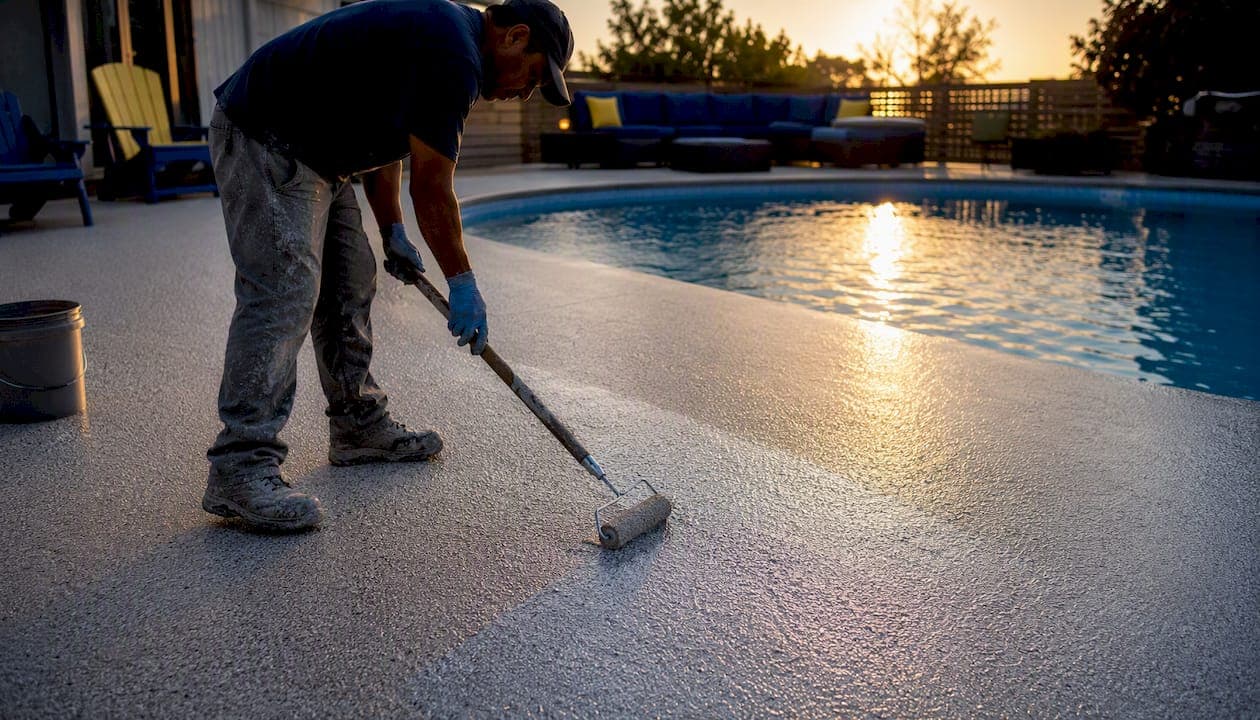
The safest, longest-lasting fix for a non slip pool deck is a professionally installed industrial-grade epoxy or polyaspartic overlay applied over diamond-ground concrete with proper moisture mitigation. This method builds a mechanical bond into the slab itself instead of sitting on top of it, so it resists the chemical etching and moisture pressure that cause cheaper fixes to fail. If your budget or timeline doesn't allow for a full overlay right now, two alternatives buy you real safety improvement:
- Anti-slip additive mixed into a clear sealer (like OxiGrip at a standard 3 oz per gallon ratio) for a subtle, barefoot-friendly texture on decks that are otherwise sound.
- Interlocking rubber tiles or rubberized decking for cushioned comfort and quick installation without touching the existing concrete.
Both work within the coefficient of friction standards professionals reference, including ADA wet-slip guidance, but neither matches the durability of a properly prepped overlay from a specialist like Showmeepoxy.
Key Takeaways
A professionally installed epoxy or polyaspartic overlay over diamond-ground concrete delivers the most durable non slip pool deck outcome available today.
| Point | Details |
|---|---|
| Prep beats product | Diamond grinding and moisture testing determine whether any coating actually bonds long term. |
| Match solution to traffic | High-use or commercial decks need overlays; low-traffic backyards can use sealer additives. |
| Watch for chemical wear | Chlorine and salt systems etch surfaces faster, so ask for chemical-resistant formulations. |
| Budget for the right tier | Sealer additives cost less upfront but need recoating every 2 to 5 years versus 5 to 15 for overlays. |
| Showmeepoxy handles the hard part | Their process pairs diamond grinding with industrial-grade epoxy and polyaspartic systems and a written warranty. |
Table of Contents
- What Makes a Pool Deck Slip Resistant Pool Surface Fail?
- Which Non Slip Pool Deck Coatings Actually Work?
- How Do You Retrofit an Existing Pool Deck?
- How Do You Choose the Right Non Slip Pool Deck Option?
- How Long Do Non Slip Pool Deck Coatings Last?
- What Do Non Slip Pool Deck Projects Cost?
- Why Professional Installation Prevents Coating Failure
- Get a Quote for Your Non Slip Pool Deck
- Frequently Asked Questions
- Sources
What Makes a Pool Deck Slip Resistant Pool Surface Fail?
Most slippery decks share the same root causes: a worn or polished finish, biofilm and sunscreen residue building up in the pores, and chemical etching from chlorine or salt systems eating away surface texture over time. Add UV exposure and repeated freeze-thaw cycles, and even a deck poured with decent texture can turn glassy within a few seasons.
- Polished or over-troweled concrete with no aggregate texture
- Soap scum, lotion, and algae film reducing traction when wet
- Chlorine and salt chemically etching the surface unevenly
- Moisture vapor pushing up from below, undermining coatings from the inside
Manufacturers like Deck-O-Seal publish wet coefficient of friction targets near .85 for their slip-resistant sealers, a useful benchmark when you're evaluating whether your current deck even comes close.
Which Non Slip Pool Deck Coatings Actually Work?
Not every "non slip" product solves the same problem, and picking the wrong one usually means redoing the work within a couple of years. Here's how the main categories stack up.
Professional epoxy and polyaspartic overlays create a mechanical bond directly into diamond-ground concrete, which is why they hold up against chlorine, salt, and UV far longer than surface-level products. The trade-off is cost and the need for a qualified installer, but for high-traffic residential decks or commercial pools, this is the option that avoids repeat projects.
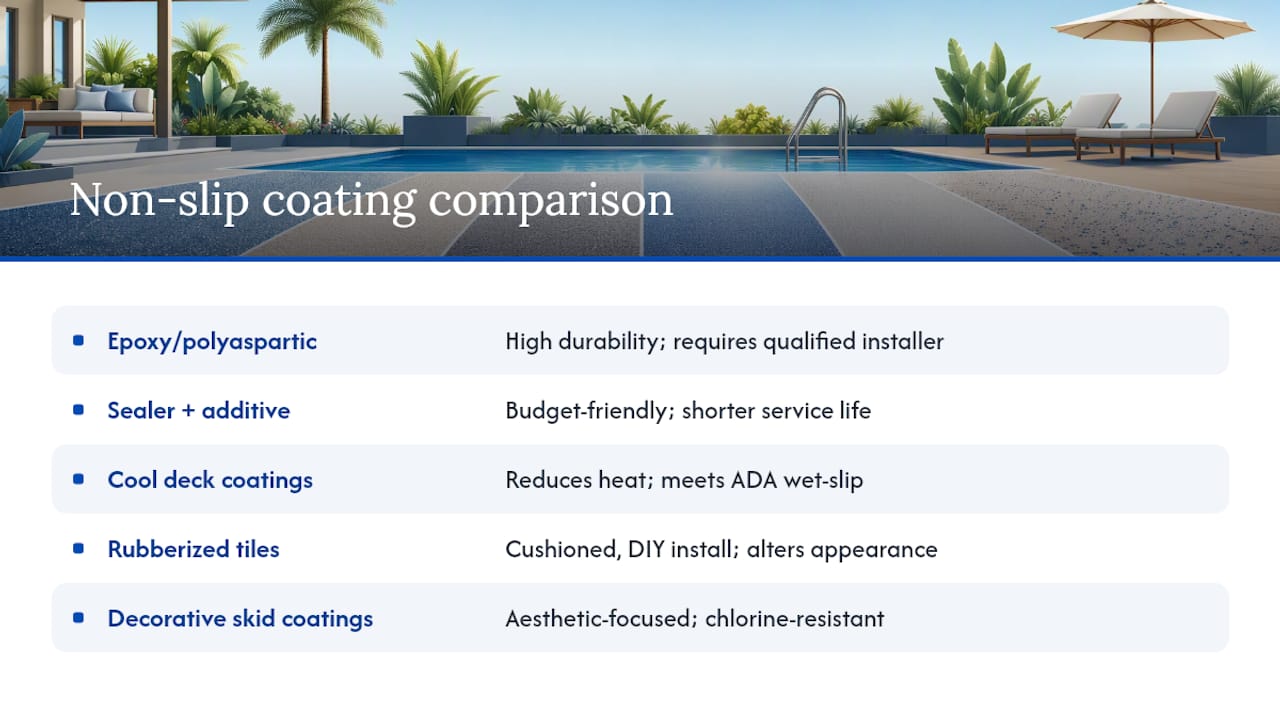
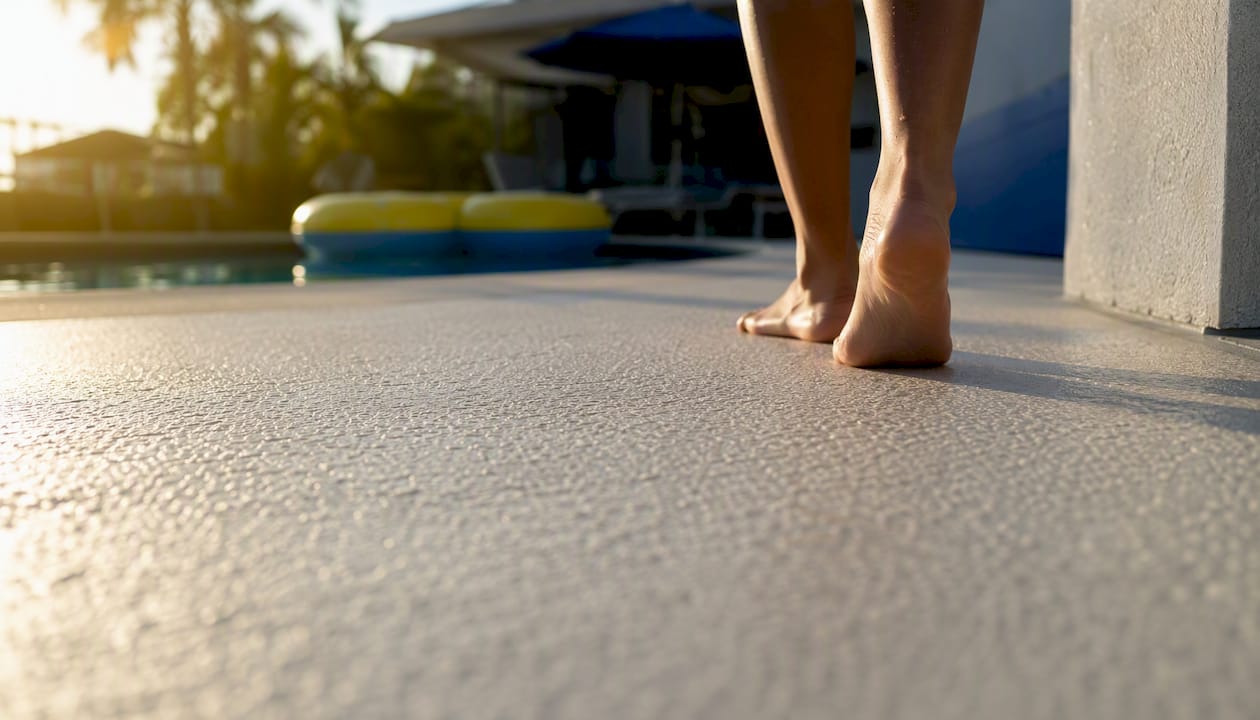
Sealer plus anti-slip additive is the budget-friendly middle ground. Products like Deck Grip or OxiGrip-enhanced sealers give a fine, sandpaper-like grit that feels comfortable underfoot rather than abrasive. Expect a shorter service life and more frequent recoating than an overlay system.
Textured concrete and reflective "cool deck" coatings, such as Encore's COOL system, tackle two problems at once: heat and traction. These coatings claim heat reduction alongside a slip-resistant finish that meets ADA wet-slip targets, making them popular in hot climates where bare feet on concrete is its own hazard.
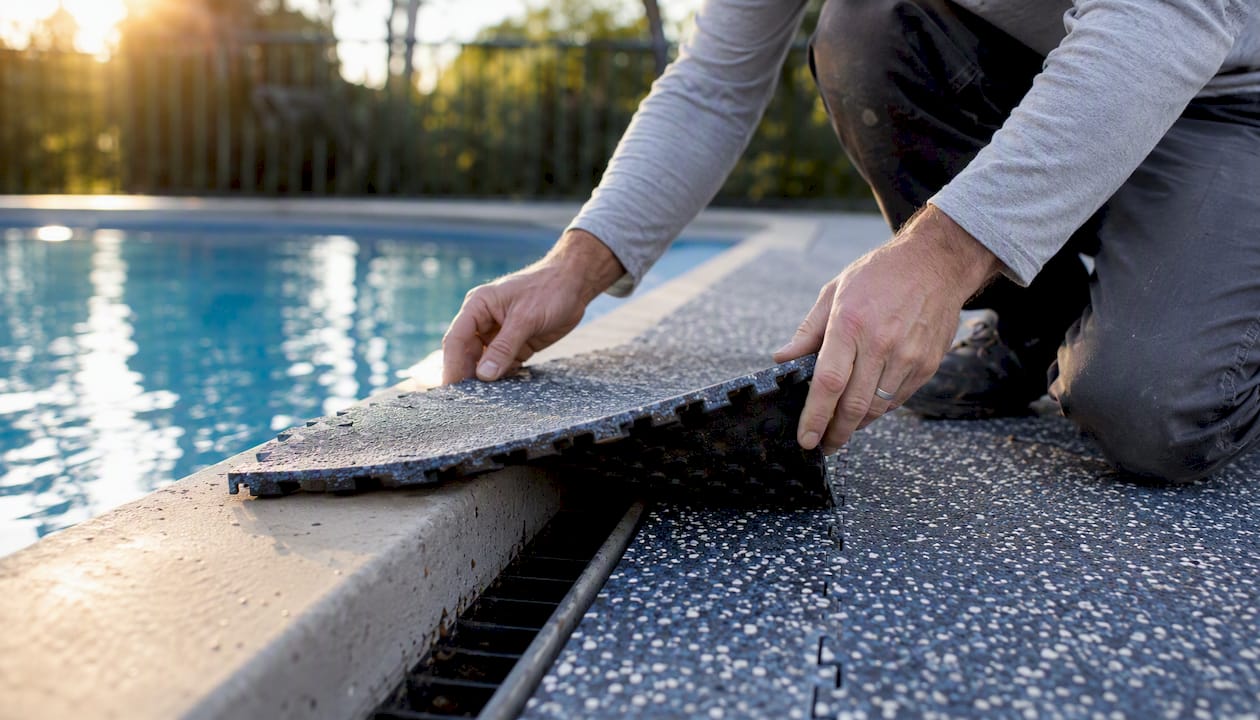
Rubberized surfacing and interlocking tiles, like the SeaDek line built originally for marine decks, offer cushioning, drainage, and reduced heat retention. Installation is fast and DIY-friendly, though they change the deck's look more dramatically than a coating would.
Decorative skid-resistant coatings, such as Skid Guard 100, work well when color and design matter as much as traction, since they're formulated to resist chlorine across wood, metal, and concrete substrates.
Reading more about how epoxy traction actually performs underfoot is worth doing before you commit to any coating category.
How Do You Retrofit an Existing Pool Deck?
Fixing a slippery deck the right way follows a sequence, and skipping steps is exactly how coatings fail early.
- Inspect and test. Check for existing coating breakdown, cracking, and signs of moisture vapor pushing through the slab.
- Clean and strip. Remove algae, soap film, and any old sealer or paint that would block adhesion.
- Diamond grind. This opens the concrete's pores and creates the mechanical profile a proper overlay bond needs, something chemical etching alone can't replicate.
- Patch and repair. Fill cracks and spalled areas before any coating goes down.
- Apply your chosen system. Mix additive into sealer at the manufacturer's ratio, or let a licensed crew install the overlay, then respect cure times before pool use resumes.
Pro Tip: The single most common DIY mistake is applying sealer over concrete that still holds moisture. Test with a plastic sheet taped down overnight. If condensation forms underneath, the slab isn't ready, and coating it now guarantees blistering later.
How Do You Choose the Right Non Slip Pool Deck Option?
Run through these questions before buying anything:
- What's your current substrate condition? Cracked or spalled concrete needs repair before any coating goes on.
- How much chemical and UV exposure does the deck get? Salt systems and full sun favor overlays over basic sealers.
- How much barefoot traffic does it see daily? High-traffic family or commercial pools justify the durability of a professional system.
- Is furniture or wheeled equipment a factor? Heavier loads point away from rubberized tiles toward hard-surface coatings.
- What's your budget and timeline? Sealer additives cost less upfront; overlays cost more but avoid near-term redo projects.
- What's your climate? Freeze-thaw regions need coatings rated for that cycling, not just chemical resistance.
When talking to contractors, ask for a specific wet COF target, written warranty terms, and an expected lifespan in writing. Vague answers on any of those three usually mean a vague installation process, too.
How Long Do Non Slip Pool Deck Coatings Last?
Maintenance needs and lifespan vary a lot by solution, and that should factor into your decision as much as upfront cost.
- Sealer with anti-slip additive: pressure wash gently and avoid harsh acid cleaners; expect 2 to 5 years before recoating.
- Professional epoxy/polyaspartic overlay: occasional mild detergent cleaning; typically lasts 5 to 15 years depending on traffic and chemical exposure.
- Rubberized tiles: rinse and mild soap; individual tiles can be swapped out as they wear rather than redoing the whole deck.
- Cool deck coatings: similar cleaning to sealers, watch for fading and re-texturing needs every few years in high-UV climates.
Traction fades gradually, not overnight. If a spot near the ladder or steps starts feeling glassy when wet, that's your signal to inspect for recoating before it becomes a fall risk.
What Do Non Slip Pool Deck Projects Cost?
Costs split roughly by material versus labor, and labor is usually the bigger share for anything beyond a DIY sealer job.
- Sealer + additive: low cost band, mostly material, 1 to 2 day turnaround including cure time.
- Cool deck / textured coating: medium cost band, split fairly evenly between labor and material, 2 to 4 days.
- Professional epoxy/polyaspartic overlay: medium to high cost band, labor-heavy due to diamond grinding and multi-coat application, 3 to 5 days for prep through cure on a mid-sized residential deck.
| Solution | Typical Cost Band | Turnaround |
|---|---|---|
| Sealer + anti-slip additive | Low | 1 to 2 days |
| Cool deck / textured coating | Medium | 2 to 4 days |
| Epoxy/polyaspartic overlay | Medium to high | 3 to 5 days |
Running your specific square footage through the free epoxy flooring cost calculator gives a faster, more accurate number than any generic range.
Why Professional Installation Prevents Coating Failure
Showmeepoxy treats surface prep as the actual product, not a step before the product. Every pool deck project starts with an assessment and moisture testing, followed by diamond grinding to open the concrete's pores, then selection of the right industrial-grade epoxy or polyaspartic system for that specific deck's exposure.
- Moisture testing before any coating touches the slab
- Diamond grinding to create a mechanical bond, not a surface-level etch
- Industrial-grade materials chosen for chlorine, salt, and UV exposure
- Written warranty backing the installation
Diamond grinding produces a mechanical profile that maximizes long-term bond, the standard professionals rely on over chemical etching, especially in pool environments where chemical exposure works against weaker adhesion methods every day.
Showmeepoxy also handles patio and outdoor epoxy installations beyond pool decks, applying the same diamond-grinding standard across every outdoor project.
When Should You DIY vs. Hire a Pro for a Pool Deck?
DIY makes sense for a small, structurally sound deck needing only a sealer refresh, a low-traffic backyard pool, or a temporary fix before a bigger renovation. Hire a professional when you're dealing with cracked or spalled concrete, a commercial or high-traffic pool, or any deck with a history of moisture problems. Property managers especially should weigh liability and warranty coverage. A failed DIY coating on a shared amenity deck is a lawsuit waiting to happen, not just a redo project.
Get a Quote for Your Non Slip Pool Deck
Showmeepoxy approaches pool decks the same way it approaches every outdoor project: diamond grinding first, industrial-grade materials second, and a finish that actually survives Missouri's freeze-thaw cycles and chlorine exposure without needing a redo in three years. That's the real difference between a weekend sealer job and a system built to last a decade.

Getting started is simple. Request an inspection, get your deck measured for an accurate quote, and schedule installation around your pool season. Showmeepoxy typically responds to quote requests quickly, so you're not left waiting through peak swimming weeks. Start with a free quote request or run your square footage through the cost calculator first if you want ballpark numbers before the call. For decks tied to a larger patio renovation, the outdoor and patio epoxy service page covers what's included.
Frequently Asked Questions
What is the most slip resistant pool deck surface? A professionally installed epoxy or polyaspartic overlay with a broadcast texture generally provides the highest coefficient of friction while staying comfortable underfoot, outperforming smooth sealers or polished concrete.
Can I make my current pool deck non slip without replacing it? Yes. Adding an anti-slip additive to a clear sealer, like OxiGrip mixed at 3 oz per gallon, improves traction on sound concrete without a full tear-out, though it needs recoating more often than an overlay.
Are rubberized pool deck tiles a good long-term option? They're strong for comfort and heat reduction and install fast, but they don't match the chemical and UV resistance of a bonded epoxy or polyaspartic system over many years of pool chemical exposure.
How often should a non slip pool deck coating be reapplied? Sealer with additive typically needs recoating every 2 to 5 years, while a professional polyaspartic overlay can last 5 to 15 years depending on traffic, chemicals, and climate exposure.
Sources
- Deck Grip – Clear Outdoor Non-Slip Sealer for Concrete and Tiles
- Anti-Slip Additive for Concrete Sealer | OxiGrip™ – Direct Colors
- DECK-O-GRIP - Acrylic, Slip-Resistant Concrete Deck Sealer - Deck-O-Seal
- Pool & Spa | SeaDek
- Decorative Non Slip Coating | Many Colors & Extremely Durable | Superior Industries, Inc.