
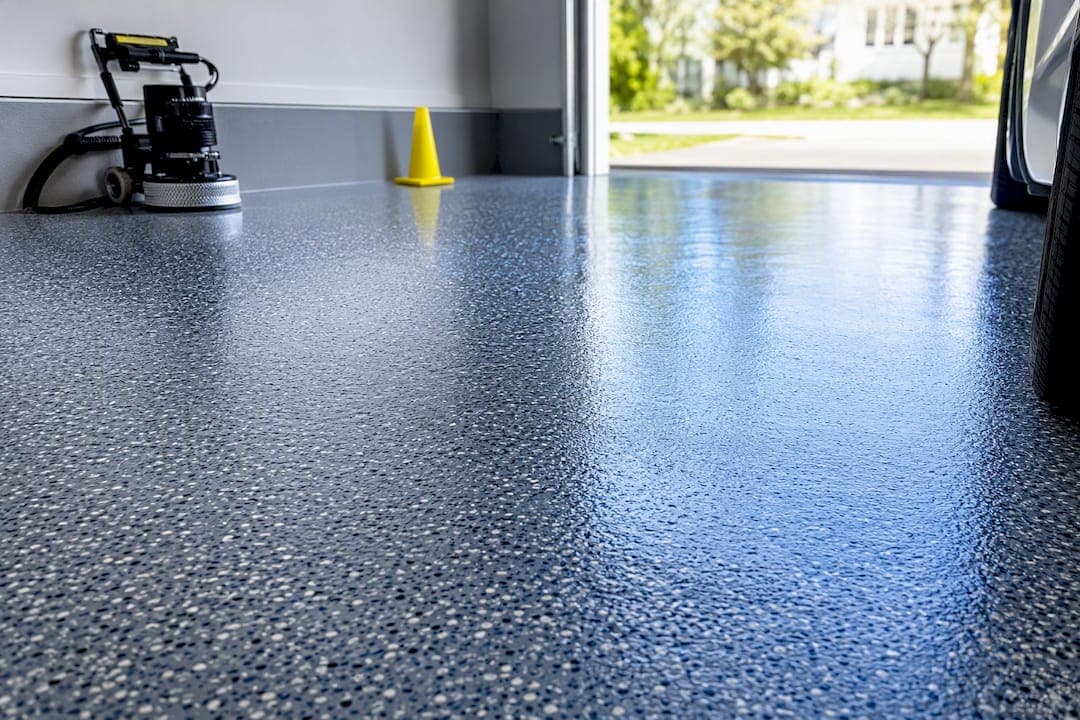
A DIY epoxy kit from a hardware store typically holds up for 1 to 5 years before peeling or yellowing sets in. A professionally installed 100% solids epoxy system with a proper topcoat runs 10 to 20 years, sometimes longer with periodic recoating. The gap between those numbers comes down to one thing: how the concrete was prepped and what topcoat sits on top of the epoxy.
TL;DR:
- Proper surface preparation with diamond grinding and moisture testing can extend epoxy floors from 5 years to over 20 years with correct installation.
- The thickness and solids content of epoxy systems, along with topcoat quality, directly impact their durability under load and UV exposure.
- Load type and traffic, especially hot tires and forklift impact, determine the appropriate epoxy strength and relevant maintenance intervals.
- Worn epoxy can often be refreshed with a topcoat if signs are cosmetic, but structural damage requires full replacement.
- Installer expertise in prep methods has a greater effect on lifespan than the epoxy brand itself, making quality surface profiling the top priority.
Table of Contents
- Epoxy Floor Lifespan by Application: What to Actually Expect
- What Actually Determines How Long Your Epoxy Floor Lasts
- Signs Your Epoxy Floor Needs Recoating or Replacement
- How to Make an Epoxy Floor Last Longer
- Why Diamond Grinding Changes the Lifespan Math
- What Manufacturer Warranties Actually Cover
- Epoxy vs. Other Flooring Options: How Long Each One Lasts
- The Real Gap Between Cheap Epoxy and a Floor That Lasts
- Get a Floor Built to Last Decades, Not Seasons
- Sources
Epoxy Floor Lifespan by Application: What to Actually Expect
The range you should plan around depends heavily on where the floor lives and what rolls, walks, or drives across it every day. A two-car garage sees very different stress than a warehouse floor taking forklift traffic eight hours a day, and the epoxy system needs to match that load.
Here's how lifespan typically breaks down by setting:
- DIY kits (residential): 1 to 5 years before noticeable peeling, hot-tire lifting, or yellowing.
- Professionally installed residential garage or basement floors: 10 to 20 years with a quality topcoat and normal household use.
- Commercial and retail spaces: generally over several years depending on foot traffic volume and cleaning chemical exposure.
- Light industrial (warehouses, workshops): 5 to 12 years before a topcoat refresh is needed, longer with mortar-broadcast systems.
- Heavy industrial (forklifts, chemical processing, mortar systems): 3 to 10 years between major recoats, since constant abrasive or chemical stress wears surfaces faster regardless of quality.
Two variables drive most of that spread: solids content and mil thickness. A DIY water-based coating typically lays down at 3 to 5 mils, roughly the thickness of a few sheets of paper. Professional 100% solids systems go down at 20 to 40 mils or more, and heavy-duty mortar systems for industrial floors can exceed that significantly. Thicker, denser material simply has more mass to wear through before it fails.
Picture a homeowner's two-car garage versus a distribution warehouse running pallet jacks and forklifts all day. Specifying the same system for both is how warranties get voided early.
What Actually Determines How Long Your Epoxy Floor Lasts
Lifespan differences between a floor that fails in two years and one that lasts twenty almost never come down to the epoxy brand. They come down to five factors, and surface prep tops the list by a wide margin.
Surface preparation matters more than any other variable. Adhesion failure from inadequate surface profiling is the leading cause of premature epoxy failure, and diamond grinding to a CSP 2-3 concrete surface profile is the industry-recommended method for creating that profile. Acid etching, the DIY-kit standard, opens microscopic pores in the concrete chemically, but it's inconsistent and leaves contaminants behind that weaken the bond. Moisture testing (measuring MVER, or moisture vapor emission rate) before installation matters just as much. Concrete slabs, especially basement slabs on grade, can emit vapor that never shows up visually until it's pushing blisters up through a finished floor.
System chemistry and thickness come next. A 100% solids epoxy cures to a dense, largely solvent-free film, while water-based formulas thin out as the carrier evaporates. Combined with a broadcast flake or quartz layer, thicker systems simply resist wear and impact longer than a thin, single-coat film.
Topcoat choice is where a lot of preventable failure happens. Straight epoxy yellows and chalks under UV exposure because polymer coatings degrade with sun exposure over time. A polyaspartic or aliphatic polyurethane topcoat blocks most of that degradation and adds abrasion resistance the base epoxy doesn't have on its own.
Traffic and load matter too. Foot traffic is gentle. Vehicle tires, especially hot tires fresh off the highway, can lift a soft or under-cured coating in a process installers call hot-tire pickup. Forklifts with hard polyurethane wheels concentrate enormous point loads that thin residential-grade coatings were never built to handle.
Pro Tip: If you park a vehicle right after a long highway drive, let the tires cool for 15 to 20 minutes before pulling into the garage. Hot rubber softens a low-quality coating just enough to grab and peel it.
Chemical exposure and cleaning habits round things out. Harsh degreasers, road salt, and abrasive scrub pads all shorten the life of a coating that wasn't specified to handle them.
Signs Your Epoxy Floor Needs Recoating or Replacement
Not every flaw means starting over. Cosmetic wear like dulling gloss, light scratching, or minor yellowing usually signals it's time for a topcoat refresh, not a full tear-out. Structural signs, like bare spots down to concrete, spiderweb cracking, or coating that lifts in sheets, point toward replacement.
- Check adhesion with a tap test. Tap a coin or hard object across the surface and listen for a hollow sound, which indicates delamination underneath.
- Inspect edges near control joints and doorways. Lifting or curling at these stress points often shows up before problems spread across the field.
- Look for blister patterns. Bubbles clustered in one area, especially on a basement slab, usually point to moisture vapor pushing up from below rather than simple wear.
- Track your recoat timeline. High-traffic residential and commercial floors typically need a topcoat refresh every 5 to 10 years; if you're well past that window and seeing structural signs, plan for replacement instead.
How to Make an Epoxy Floor Last Longer
Getting a 15 to 20 year floor instead of a 5 year one starts before a single drop of epoxy hits the concrete. What you specify, and what you do afterward, matters more than which brand of epoxy ends up in the bucket.
Before installation, insist on these specs:
- Diamond grinding to a CSP 2-3 profile, not acid etching.
- Moisture testing (MVER) on any slab, especially basements or slab-on-grade construction.
- A 100% solids epoxy base rather than a thinned water-based formula.
- Mil thickness appropriate to the traffic load, with broadcast flake or quartz for high-wear areas.
- A polyaspartic or aliphatic polyurethane topcoat for UV stability and abrasion resistance.
The topcoat decision alone often delivers the biggest jump in real-world durability, since it directly addresses the two most common early failure points: UV yellowing and hot-tire pickup.
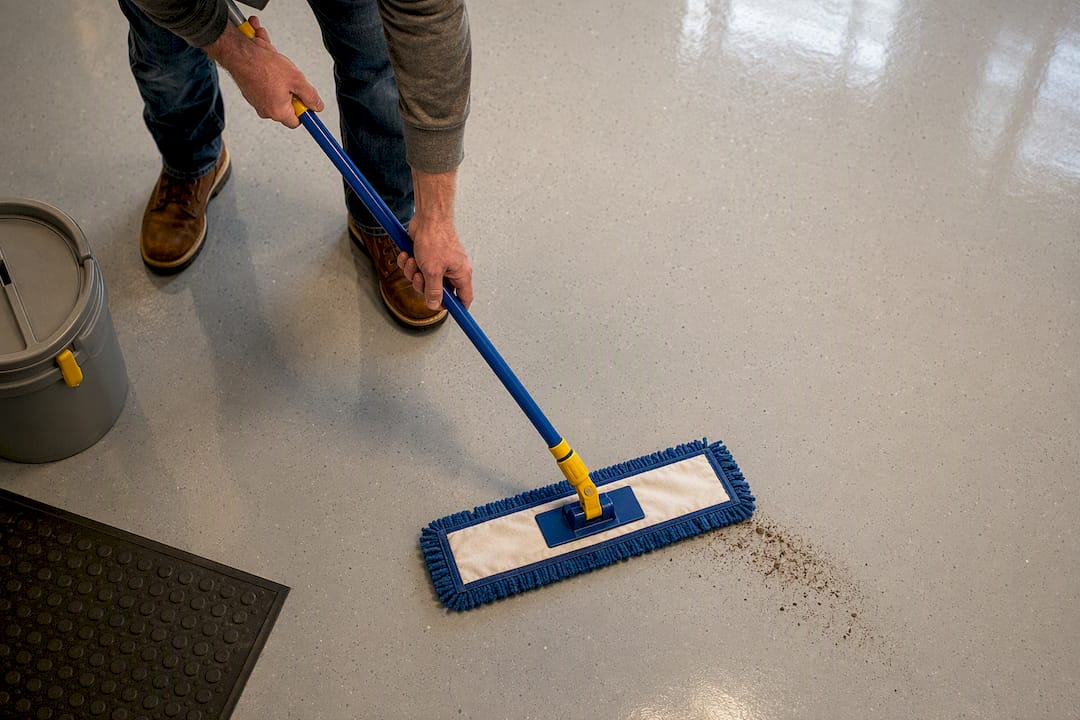
Once the floor is down, maintenance is straightforward but easy to skip. Sweep or dust-mop regularly to keep grit from acting like sandpaper under foot traffic. Use pH-neutral cleaners instead of ammonia-based or acidic products, which slowly break down the topcoat's chemical resistance. Wipe up chemical spills, oil, and antifreeze promptly rather than letting them sit. Put mats under jack stands, tool chests, or anything with small hard casters.
Think about lifecycle cost rather than one-time cost. A proactive topcoat refresh every 5 to 10 years, depending on traffic, generally costs a fraction of a full tear-out and reinstall. Planning for that refresh from day one is cheaper than reacting to failure.
Why Diamond Grinding Changes the Lifespan Math
Diamond grinding removes the weak, contaminated top layer of concrete and cuts a mechanical profile the epoxy can physically key into, rather than just sitting on a chemically etched surface. That's the difference between a coating that's bonded and one that's merely sitting there waiting to lift. Mechanical profiling consistently outperforms acid etching for long-term adhesion, which is why Showmeepoxy uses diamond grinding as a standard step, not an upsell, on every installation.
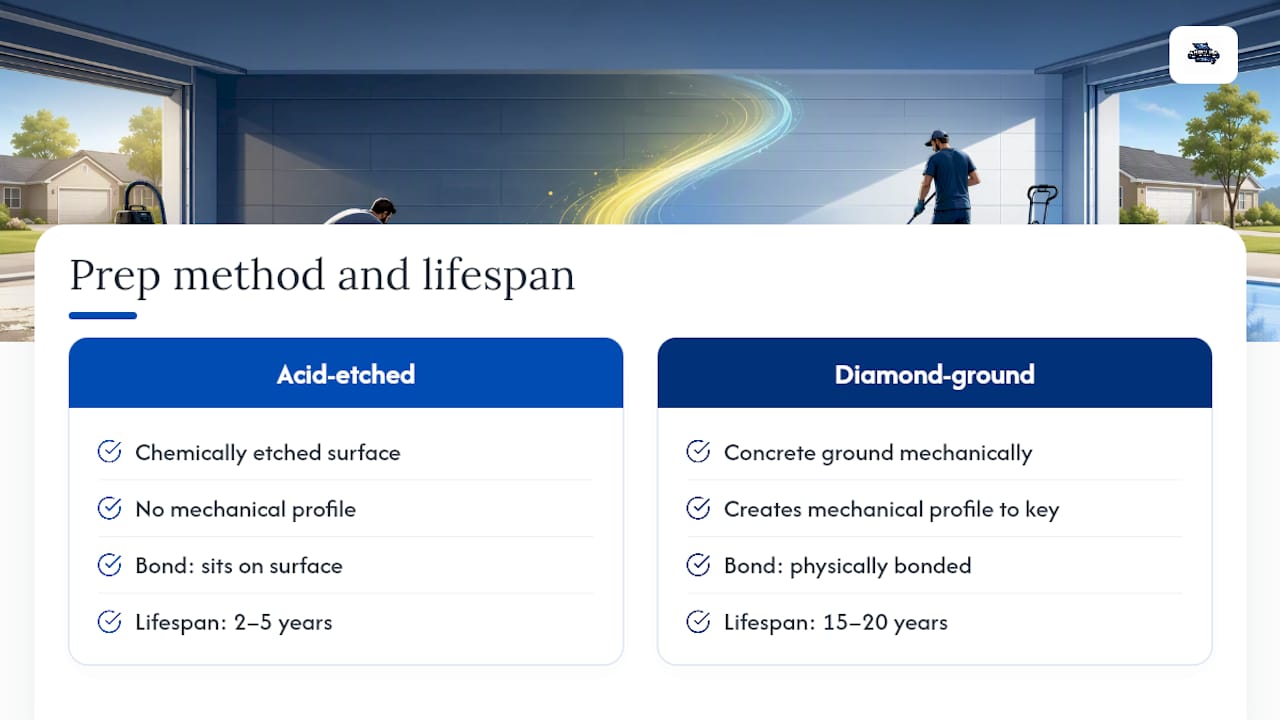
Combined with moisture testing before the epoxy ever goes down, that prep process is what turns a floor from a five-year gamble into a fifteen-to-twenty-year investment. Homeowners and property managers researching garage floor installations consistently report that floors installed with proper grinding and a quality topcoat hold their gloss and color years after cheaper installs have already failed. Stephen, who covers flooring durability and installation methods for Showmeepoxy, has tracked these patterns across residential and commercial jobs throughout Mid-Missouri.
What Manufacturer Warranties Actually Cover
Most epoxy product manufacturers warranty their material against defects, not against installation error, and that distinction matters more than the warranty length itself. A 15-year manufacturer warranty on the resin means nothing if the installer skipped moisture testing or used acid etch instead of mechanical grinding, since virtually every warranty excludes failures tied to substrate prep or moisture intrusion.
Warranty lengths vary widely by product tier. Basic water-based DIY products often carry warranties of a year or less, if any coverage exists at all. Mid-tier professional epoxy systems commonly carry warranties in the 5 to 10 year range covering material defects like improper cure or delamination not caused by moisture or substrate issues. Premium 100% solids systems with polyaspartic topcoats sometimes extend coverage further, particularly when the installer follows the manufacturer's specified prep protocol to the letter.
Read the exclusions section before comparing warranty numbers between installers. A shorter warranty backed by documented diamond grinding and MVER testing is worth more in practice than a longer warranty on a floor with no surface prep behind it, because the latter is likely to void on a technicality the first time something goes wrong.
Epoxy vs. Other Flooring Options: How Long Each One Lasts
Comparing epoxy to alternatives only makes sense when you match comparable installation quality on both sides. Sealed or stained bare concrete lasts indefinitely as a substrate but offers little abrasion or chemical resistance, and sealers typically need reapplication every 1 to 3 years in high-traffic areas. Vinyl composition tile in commercial settings runs roughly 10 to 20 years with routine waxing, similar to a quality epoxy system, but it seams and can lift at edges in wet environments where epoxy stays monolithic and seamless. Polished concrete lasts as long as the slab itself but lacks the chemical and stain resistance a topcoated epoxy system provides in a garage or shop.
Carpet and standard vinyl sheet flooring generally fall well short of epoxy in garages, basements, and commercial floors, typically needing replacement every 5 to 10 years under moderate use, faster under heavy traffic or moisture exposure. For spaces dealing with vehicle traffic, chemical spills, or heavy foot traffic, a properly installed epoxy system tends to outlast most alternatives on a cost-per-year basis, even though the upfront price often runs higher than carpet or basic vinyl.
The Real Gap Between Cheap Epoxy and a Floor That Lasts
The conventional advice on epoxy flooring treats it like a single product category, as if "epoxy" tells you anything meaningful about how long a floor will hold up. It doesn't. That gap, 2 to 5 years versus 15 to 20, is the single most important thing a homeowner or property manager researching this topic needs to internalize before comparing prices.
What gets overrated: the brand of epoxy itself. What gets underrated: moisture testing and mechanical surface profiling, the unglamorous steps that happen before any coating goes down. If you take one thing from everything above, prioritize the installer's prep process over the product name on the bucket. Ask specifically about diamond grinding versus acid etch, and ask whether they test for moisture vapor before quoting a basement job. Those two questions filter out most of the installers who'll hand you a floor that looks great for six months and fails by year three.
— Stephen
Get a Floor Built to Last Decades, Not Seasons
If the ranges above make one thing clear, it's that the installer's process matters more than the product label. Showmeepoxy builds every job around diamond-grinding prep and moisture testing as standard practice, not an add-on, which is exactly the combination this article identifies as the difference between a 5-year floor and a 20-year one.

Homeowners in Columbia can start with the garage floor coatings page, and anyone dealing with a damp or unfinished basement can look at basement epoxy flooring options built around proper vapor mitigation. For everyone else, the fastest path is a free, no-pressure quote where you can ask directly about prep methods before committing to anything.
Sources
- How Long Does Epoxy Floor Last? Lifespan Guide — D and G Flooring
- Degradation and nanofiller release of polymer nanocomposites exposed to UV — NIST