
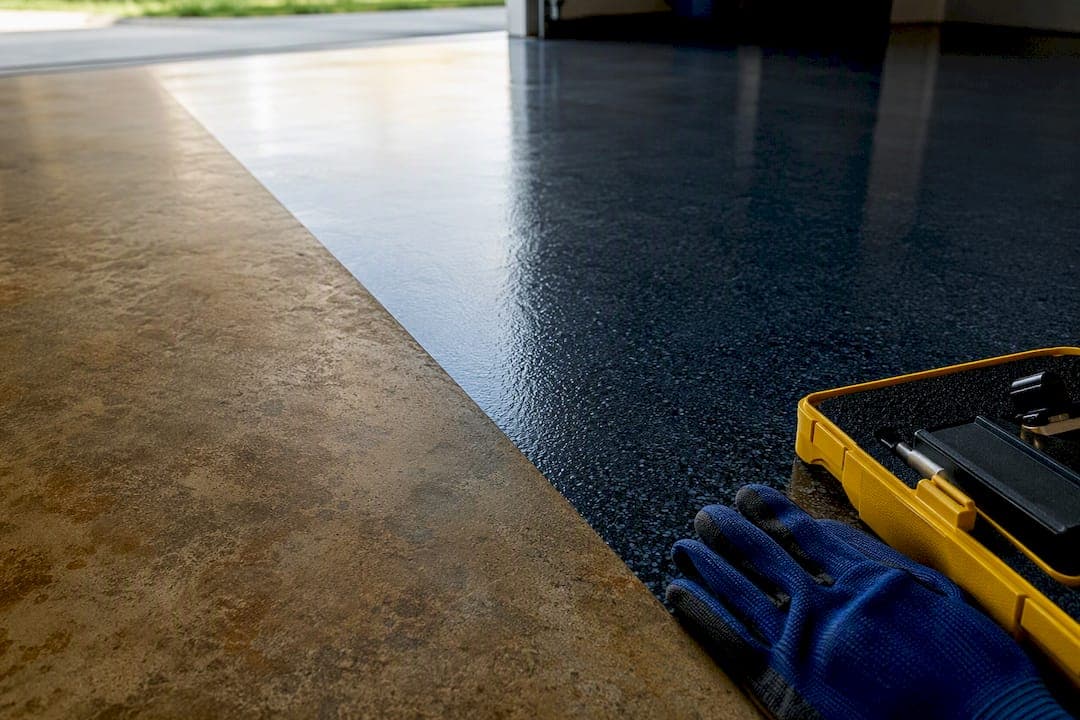
For working garages, workshops, and any floor that has to shrug off oil, chemicals, and impact, epoxy is the better choice. For natural-looking interior floors, patios, and any surface that sits under direct sun, stained concrete usually wins. The trade-off comes down to this: epoxy builds a protective film on top of your slab, while stain becomes part of the slab itself, permanently.
TL;DR:
- Epoxy flooring is essential for garages and workshops exposed to chemicals and impact, but requires proper prep and attention to moisture to last.
- Stained concrete is best for natural, sunlit spaces like patios and interiors, as its color is embedded and UV stable without yellowing over time.
- Professional epoxy systems with high solids content and diamond grinding surface prep outperform DIY kits that tend to peel or fail early.
- Resealing stained floors every three to five years maintains appearance, while epoxy may only need a professional recoat after damage or wear.
- Cost differences diminish over time, as proper installation prevents early failures, and stain’s lower starting price can be offset by long-term maintenance.
Table of Contents
- Epoxy vs Stained Concrete: A Quick Priority Match
- What Is Epoxy Flooring, Exactly?
- What Is Stained Concrete, and What Does It Look Like?
- Comparing Epoxy and Stained Concrete Head to Head
- Which Finish Fits Your Space?
- What Will It Actually Cost, and How Long Will It Last?
- Installation Prep: What to Verify Before You Sign a Contract
- Keeping Either Floor Looking Right for Years
- How Show Me Epoxy Approaches Installation
- The Bottom Line on Epoxy vs Stained Concrete
- What Homeowners Get Wrong About This Decision
- Ready for a Floor That's Built to Last?
- Sources
Epoxy vs Stained Concrete: A Quick Priority Match
Before you fall down a rabbit hole of finish samples and contractor quotes, match your priority to the right column below.
Epoxy fits you if:
- You park vehicles, run power tools, or drop chemicals and motor oil regularly
- You want a seamless, easy-to-hose-down surface
- You're finishing a garage, workshop, or commercial floor
Stained concrete fits you if:
- You want a natural, variegated look that reads as "real floor," not "coating"
- Your space gets direct sunlight for hours at a time
- You're finishing a living room, sunroom, or patio
The mechanical difference explains almost everything else in this comparison. Stain is a dye that soaks into the porous surface of the slab, so the color becomes permanent, it can't chip or peel, and it never delaminates. Epoxy is a resin coating that cures into a hard film sitting on top of the concrete, which is why it can resist chemicals so well but is also the one that can lift, bubble, or yellow if something underneath goes wrong.
On cost, stained concrete typically starts lower per square foot than most epoxy systems, though maintenance and reseal costs over a decade or two narrow that gap. Durability also splits by task rather than by price: stain resists scratching well because the color lives inside the slab, but epoxy resists chemical spills, hot tires, and abrasion in ways plain sealed concrete never will.
Maintenance cadence differs, too. Stained floors need resealing periodically depending on foot traffic. Epoxy floors, once properly installed, often run longer between maintenance needs, but a damaged epoxy floor usually needs a professional recoat rather than a quick touch-up.
What Is Epoxy Flooring, Exactly?
Epoxy flooring is a two-part resin system, a hardener mixed with a resin, that chemically cures into a rigid plastic coating bonded to your concrete. Not all epoxy is created equal, and the gap between a big-box DIY kit and a professional installation is the single biggest factor in how long a floor lasts.
Consumer kits are usually thinned down, low-solids formulas designed for easy rolling. Professional-grade epoxy runs closer to 100% solids, meaning almost none of the material evaporates during cure, which is what gives it real thickness and chemical resistance. Standard consumer epoxy kits typically fail much sooner in an active garage, while a properly installed 100% solids system paired with mechanical surface prep performs for years longer under the same conditions.
A full epoxy system typically layers several coats:
- Primer: soaks into the prepared concrete and creates the bonding layer
- Base coat: the pigmented color layer, sometimes broadcast with decorative flakes or metallic pigments
- Topcoat: a clear protective layer, often polyaspartic or polyurea for better UV resistance and faster cure
Performance comes down to a few measurable factors: chemical resistance (can it handle brake fluid, gasoline, salt?), hardness (does it dent under a jack stand?), and how seamlessly the coats bond to each other and to the slab. Standard epoxy systems can yellow under prolonged UV exposure and are sensitive to moisture moving up through the slab, which is why delamination, not scratching, is the most common failure mode.
Pro Tip: Skip the roll-on kits from the hardware store for any garage where you actually work on cars or run machinery. They look fine on day one and start lifting at the tire tracks within a year.
What Is Stained Concrete, and What Does It Look Like?
Stained concrete falls into two families, and they produce genuinely different results. Acid stains react chemically with the minerals in your concrete, producing a mottled, variegated look where no two floors ever come out identical, closer to natural stone or leather than paint. Water-based stains work more like a dye. They offer a much broader color palette, including blues, greens, and other tones acid chemistry can't produce, with a flatter, more uniform finish.
Because stain penetrates the slab rather than sitting on top of it, the color becomes permanent. It won't peel or flake because it's chemically part of the concrete itself. That also means repairability works differently than epoxy: you can't "recoat" a worn stain the way you can recoat epoxy. Wear that shows up over time is almost always the sealer breaking down, not the color fading.
That sealer does the actual protective work, and it needs periodic attention:
- Expect to reseal every few years depending on foot traffic and sun exposure
- Watch for dulling, water no longer beading on the surface, or a chalky texture as signs a reseal is overdue
- Resealing is a same-day job in most rooms, no grinding or recoloring required
Stained concrete tends to win on aesthetics for anyone chasing a natural, organic, high-end look, especially in living rooms, dining areas, and covered patios where the goal is a floor that looks like it belongs to the house, not a coating applied over it.
Comparing Epoxy and Stained Concrete Head to Head
Durability splits by threat type more than by overall toughness. Epoxy handles chemical spills, hot tire pickup, and heavy abrasion better than almost anything else you can put on concrete. Stain handles scratching and everyday wear well since the color can't chip, but it offers no meaningful chemical barrier against motor oil or de-icing salt.
| Factor | Epoxy | Stained concrete |
|---|---|---|
| Best for | Garages, workshops, commercial floors | Living areas, patios, sun-exposed spaces |
| Chemical resistance | High | Low to moderate (sealer-dependent) |
| Maintenance frequency | Occasional recoat, easy daily cleaning | Reseal every 3 years |
| Cost per sq ft | Higher, varies by system | Lower starting point |
| Install/cure time | 2 days, cure windows matter | Faster, minimal cure downtime |
| UV/outdoor suitability | Needs polyaspartic/polyurea topcoat | Naturally UV-stable |
| Design options | Flakes, metallics, solid colors | Acid mottling, water-based color range |
| Repairability | Full recoat needed for damage | Reseal, not recolor |
Cost gaps matter less than people think once you zoom out to a ten-year window. Stained concrete often starts around $2 to $4 per square foot, while epoxy systems typically start at a higher price depending on the number of coats and topcoat type, but reseal cycles on stain add up, and a cheap epoxy job that delaminates in two years ends up costing more than either option done right the first time.
UV stability is where a lot of homeowners get surprised. Standard epoxy topcoats can yellow in direct sun over months, not years. If you want epoxy on a sun-exposed patio, you need a polyaspartic or polyurea topcoat, which cures faster and holds color far longer than a basic epoxy topcoat. Stain has no such problem. It's mineral-based color locked into the concrete, immune to UV breakdown by nature.
Installation prep separates a floor that lasts from one that doesn't, regardless of which material you choose. Epoxy needs a mechanically ground surface, usually diamond grinding, to create a profile the resin can grip. Stain needs a clean, properly cured slab but tolerates less aggressive prep since it's a chemical or dye reaction rather than a physical bond.
Which Finish Fits Your Space?
- Garage: Choose epoxy if you work on vehicles, run tools, or expect chemical spills. A light-use or "show" garage that mostly parks cars can get away with stain, though it won't resist an oil leak the way epoxy does.
- Basement: Test for moisture before choosing anything. High vapor emission through a slab causes epoxy to delaminate, so basements need moisture mitigation first or an epoxy system rated for moisture-tolerant installation. Stain paired with the right sealer is a safer default if you skip that testing.
- Patio or outdoor space: Lean toward stain, or an epoxy system specifically topcoated with polyaspartic or polyurea for UV resistance. Sun-exposed areas favor stain because it won't yellow the way standard epoxy can.
- Interior living areas: Stain usually wins for the organic, natural look most homeowners want in a living room or dining space. Epoxy makes sense if you're chasing a polished, commercial-grade finish instead, like a modern loft aesthetic.
What Will It Actually Cost, and How Long Will It Last?
Budget ranges vary by system complexity, but here's the general shape of it. Stained concrete typically runs $2 to $4 per square foot for basic acid or water-based stain with sealer, before jumping higher for multi-color or decorative saw-cut work. Epoxy runs from around $3 to $7 per square foot for a solid-color system, climbing higher for flake or metallic finishes with polyaspartic topcoats.
On a 400 square foot floor, roughly a 20 by 20 foot garage or den:
- Basic stained concrete: roughly $800 to $1,600 installed
- Solid-color epoxy: roughly $1,200 to $2,800 installed
- Flake or metallic epoxy with a UV topcoat: often $2,800 and up
Long-term costs favor whichever system matches its environment. Stain needs periodic resealing, which adds ongoing maintenance costs compared to occasional full recoating for epoxy. Epoxy done right with proper prep and materials can last many years without major intervention, but a botched installation, thin DIY coating, or skipped moisture test can mean a full recoat within a couple of years, wiping out any upfront savings. Curious how the math plays out over a longer horizon? This breakdown on epoxy's long-term value walks through the return-on-investment side in more detail.
Installation Prep: What to Verify Before You Sign a Contract
Most epoxy failures trace back to two things: skipped mechanical prep and ignored moisture. Diamond grinding removes the top layer of concrete and opens a rough profile that the resin can physically key into. Chemical or acid etching, by contrast, just changes the surface chemistry slightly and leaves a shallower bond, which is a major reason DIY-grade installations fail so much sooner than professional ones.
Moisture is the other silent killer. A high moisture vapor emission rate, measured through MVER testing, pushes water vapor up through the slab and lifts epoxy from underneath, regardless of how well the topcoat looks on day one. Basements and ground-level slabs carry the highest risk here, and if your existing concrete has visible spalling or surface damage, addressing that repair before any coating goes down is non-negotiable.
Red flags to watch for when you're comparing quotes:
- No mention of moisture testing at all
- Skipping grinding in favor of a quick acid wash
- A price that's noticeably lower than every other quote you got
- A contractor recommending a consumer-grade kit for a working garage or commercial space
Pro Tip: Ask every contractor for their actual MVER numbers and a written prep plan before you sign anything. If they can't produce either, that's your answer. If moisture is a known issue in your basement, it's worth reading up on vapor barrier versus full encapsulation before committing to a coating.
Keeping Either Floor Looking Right for Years
Daily upkeep is simple for both. Sweep regularly, mop with a pH-neutral cleaner, and skip anything acidic or abrasive, especially on sealed stain, where harsh chemicals can strip the topcoat faster than normal wear ever would.
Stained floors signal they need attention when water stops beading on the surface or the finish looks dull and chalky. That's your cue to reseal, typically every three to five years. Epoxy sends different signals: chips, scratches, or a cloudy patch usually mean localized damage rather than a full system failure, and a professional recoat on just that section can often solve it without redoing the whole floor. Understanding roughly how long an epoxy garage floor should last helps you tell normal wear from an actual installation problem.
A few habits extend either finish considerably:
- Use mats under vehicles that leak or drip regularly
- Specify a UV-stable topcoat any time epoxy will see direct sun
- Reseal stain on schedule rather than waiting for visible damage
How Show Me Epoxy Approaches Installation
Most epoxy problems trace back to shortcuts in prep, not the resin itself. Show Me Epoxy builds every installation around diamond-grinding surface preparation, the mechanical process that creates a real bonding profile instead of relying on a shallow chemical etch. That single step is the difference between a floor that lasts and one that starts lifting at year two.
Industrial-grade materials paired with that prep work create what amounts to a permanent bond rather than a coating that's merely resting on the surface. For basements specifically, moisture mitigation happens before any epoxy goes down, addressing the vapor emission issue that causes most premature failures in ground-level installations.
What this means practically for your project:
- Surface prep is mechanical (diamond grinding), not chemical etching alone
- Moisture testing happens before basement installations, not after problems appear
- Materials are industrial-grade rather than consumer-kit formulations
- Installation timelines stay quick without skipping the steps that determine longevity
If you're getting quotes for any epoxy project, garage, basement, or otherwise, ask for the same thing every time: a written prep plan and moisture test results before signing.
The Bottom Line on Epoxy vs Stained Concrete
Match the finish to the job, not the trend. Working garages and workshops call for epoxy because nothing else resists oil, chemicals, and impact the way a properly installed epoxy system does. Patios, sun-exposed rooms, and interiors chasing a natural look call for stain.
Before you decide, answer three questions: What's the primary use of this space? How much chemical or UV exposure will it actually see? And how much ongoing maintenance are you willing to tolerate? If epoxy is on the table, insist on a moisture test and a written prep plan before signing anything.
What Homeowners Get Wrong About This Decision
The conventional framing treats this as an aesthetic choice: which floor looks better. That's backwards. The decision that actually holds up over time is about exposure, not appearance. A gorgeous stained floor in a garage that sees regular oil changes will look tired within a couple of years, and a beautiful epoxy floor on an uncovered patio will start yellowing before you've finished paying it off.
The bigger blind spot is installation quality. Homeowners spend weeks comparing flake colors and barely ask about moisture testing or grinding versus etching, even though installation quality determines success more than the product itself. A mediocre contractor with premium epoxy will underperform a meticulous one with a mid-tier product almost every time.
If there's one thing to prioritize first, it's this: figure out your exposure conditions (moisture, sun, chemicals) before you fall in love with a finish. The right material for a moist basement or a sun-baked patio is often decided by physics, not preference. Everything else, color, texture, budget, comes after that.
— Stephen
Ready for a Floor That's Built to Last?
If your garage in Mid Missouri is due for a real upgrade, not another coating that peels in a year, There are local options that focus on addressing moisture and preparation issues that cause many epoxy flooring failures. Some installations start with diamond-grinding surface preparation, a mechanical bonding step sometimes skipped by budget installers, paired with industrial-grade materials suitable for typical garages, basements, and outdoor spaces rather than showroom conditions.

That approach matters most in basements, where moisture mitigation happens before the epoxy ever goes down, and in working garages, where a shortcut on prep is the single biggest reason floors fail early. Installation runs quick without cutting the steps that determine whether your floor lasts five years or fifteen.
If you're in the area, consider requesting a quote that includes a detailed preparation plan. Visit Show Me Epoxy to request a free consultation, or check the Jefferson City garage coating page or Columbia garage coating page for local specifics before you commit to anything.
Sources
- ConcreteNetwork — Stained concrete overview
- Concrete Captain — Epoxy vs stained concrete
- Copps Industries — UV-resistant epoxy discussion