
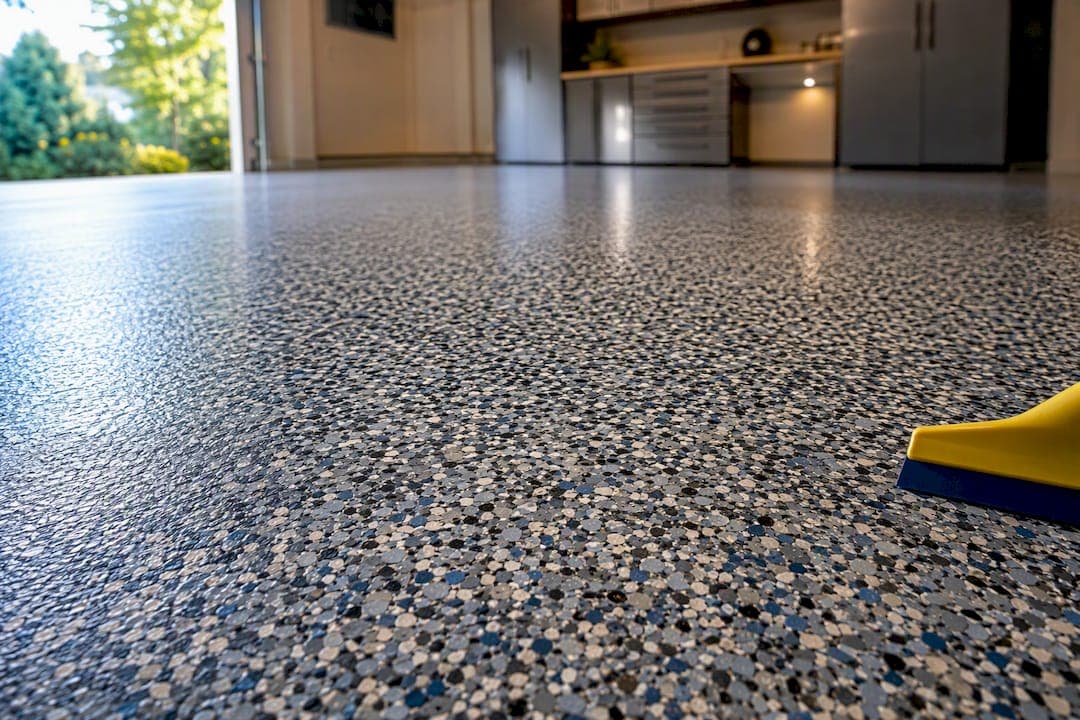
Pick one dominant color family, match your base coat to that family's tone, and build a 3 to 4 color blend with a single accent making up 10% to 20% of the mix. Go with full broadcast if you want a modern, seamless look and easier upkeep. That's a common rule used by many professionals, and it's an effective way to narrow a wall of flake samples down to a floor you'll still like in five years.
TL;DR:
- Gray-scale blends are the most popular and practical, with charcoal and medium gray bases hiding dirt better than lighter or bolder options.
- Medium-sized flakes (around 1/4 inch) and full broadcast application produce a balanced, durable, and seamless look suitable for garages and basements.
- Matching the base coat color to the dominant flakes ensures a cohesive appearance, especially in partial broadcast systems where gaps are visible.
- Viewing sample boards under the actual room lighting and curing them with the final topcoat prevents surprises and guides accurate color choices.
- Cleaner, more consistent results are achieved through diamond grinding surface prep and pre-built sample boards, reducing common DIY mistakes and installation regrets.
Table of Contents
- Standard Flake Color Palettes and Which Ones Fit Your Space
- How Flake Size and Broadcast Density Change the Look
- Proven Blend Formulas You Can Copy
- Why Matching Your Base Coat to Your Flake Blend Matters
- Matching Palettes to Garages, Basements, and Showrooms
- Building Sample Boards Before You Commit
- Flake Combinations Worth Copying
- Durability and Upkeep Differences Between Blends
- How Lighting Changes the Way Flake Colors Read
- Flake Compatibility With Epoxy, Polyaspartic, and Polyurethane Systems
- What's Trending in Flake Color Combinations Right Now
- Common Mistakes When Selecting Flake Color Combinations
- An Installer's View on What Actually Holds Up
- Get a Sample Board and a Free Quote
- Where to See More Flake Colors and Blend Ideas
- Sources
- FAQ
Standard Flake Color Palettes and Which Ones Fit Your Space
Every flake manufacturer organizes its options into a handful of predictable families, and each one signals something different about the room it's going into.
Gray-scale blends dominate the market for a reason. Charcoal, slate, and dove gray mixed together read as clean and industrial without showing every speck of dust, which is why gray combinations account for roughly 45% of residential flake installs. A starter blend of medium gray, black, and white photographs well and hides tire marks in a garage.
Earth tones run tan, mocha, and cream, and they tend to suit basements and rec rooms where you want warmth instead of a shop-floor feel.
Bold multi-color blends throw in reds, yellows, or greens against black or charcoal.
White and light blends lean bright and airy, great for showrooms where color rendering under LED lighting matters more than dirt camouflage. Metallic accent flakes add a subtle shimmer to any of the above families without changing the base palette.
- Gray-scale: charcoal + medium gray + white, or slate + black + silver
- Earth tone: tan + brown + cream, or terracotta + sand + espresso
- Blue/coastal: navy + slate blue + white, or teal + gray + cream
Darker, denser families like gray-scale and earth tones hide dirt better over time. Lighter and bolder blends look sharper in photos but show grime faster between cleanings.
How Flake Size and Broadcast Density Change the Look
Flake size and how much of it you scatter across the floor change the entire personality of the finish, sometimes more than the colors themselves.
- Large flakes (around 1 inch) create a terrazzo-like look with visible individual chips and a lot of open base coat between them on partial broadcasts. This size works well in showrooms and retail spaces where a bold, architectural pattern is the goal.
- Medium flakes (around 1/4 inch) are the most common choice for garages and basements. They give a balanced, speckled texture that's dense enough to look finished but still shows some depth.
- Fine flakes (around 1/16 inch) produce a tight, uniform speckle that reads almost like a solid color from a few feet away. Fine blends suit patios and commercial floors where a subtle texture matters more than a statement pattern.
Broadcast density is the other lever. Full broadcast covers the base coat entirely, so the flake blend does all the visual work and the base color barely matters. Partial broadcast leaves gaps where the base coat peeks through, which can look intentional and rustic or messy and unfinished depending on how carefully it's done. For garages and basements that see daily wear, full broadcast with medium flakes is the safest bet.
Proven Blend Formulas You Can Copy
You don't need to guess at ratios. Market data on installed floors points to a handful of blends that consistently produce a balanced, professional result, and they all follow the same underlying logic: three or four colors, with one accent color capped around 10% to 20% of the mix so it reads as a highlight instead of competing for attention.
| Blend name | Color breakdown | Recommended base coat |
|---|---|---|
| Neutral gray | medium gray, black, white | charcoal or medium gray |
| Warm earth | tan, brown, cream | Tan or mocha |
| Coastal blue | navy, slate blue, white | Dark gray |
| Bold accent | black, white, red accent | Black |
These starter ratios work because the human eye reads a dominant color as the "base" of the floor and treats the smaller percentages as texture and interest. Drop below three colors and the floor can look flat and one-note, especially under bright lighting.
Pro Tip: If you're blending loose chips yourself rather than buying a pre-mixed bag, mix your entire batch in one large container before broadcasting. Scooping straight from separate color bags as you go almost always produces uneven patches where one color clusters more heavily in certain areas of the floor.
Why Matching Your Base Coat to Your Flake Blend Matters
The base coat is the color underneath your flakes, and it's the single most overlooked decision in the entire process. Get it wrong and you'll see it in every gap between chips for the life of the floor.
The rule is simple: match the base coat to whatever color dominates your flake blend. Gray blends want a charcoal or medium-gray base. Earth tone blends want tan or mocha. Blue blends do best on dark gray. Bold blends need black underneath to keep stray gaps from looking like mistakes.
- A white base under a gray-dominant blend leaves bright, distracting gaps wherever flakes don't fully cover
- A tan base under a bold red-and-black blend creates a muddy, uneven look instead of clean contrast
- A charcoal base under a light, white-dominant blend can darken the whole floor and mute the intended airy feel
This is where broadcast density changes the stakes considerably. On a full broadcast floor, the base coat disappears entirely under the flakes and its color becomes almost irrelevant. On a partial broadcast, where gaps are part of the design, base coat selection is the difference between a floor that looks intentional and one that looks unfinished.
Matching Palettes to Garages, Basements, and Showrooms
The right blend depends less on personal taste and more on how the room gets used, how much light it gets, and what you're trying to project.
- Garages: gray-scale or bold blends with medium flakes and full broadcast hide tire marks, oil residue, and daily wear the best.
- Basements: earth tones or lighter gray blends with medium to fine flakes work well, especially paired with a moisture-resistant system since basements bring their own prep challenges.
- Showrooms and retail spaces: white/light blends or large terrazzo-style flakes create a premium look under bright, even lighting.
- Patios and outdoor areas: fine flakes with UV-stable topcoats hold color better under direct sun; polyaspartic systems resist UV yellowing better than standard epoxy over time.
Before settling on a blend, ask yourself three questions: How much foot or vehicle traffic will this floor see daily? Is the space lit mostly by daylight, LED, or both? Is the priority hiding dirt or making a visual statement?
Building Sample Boards Before You Commit
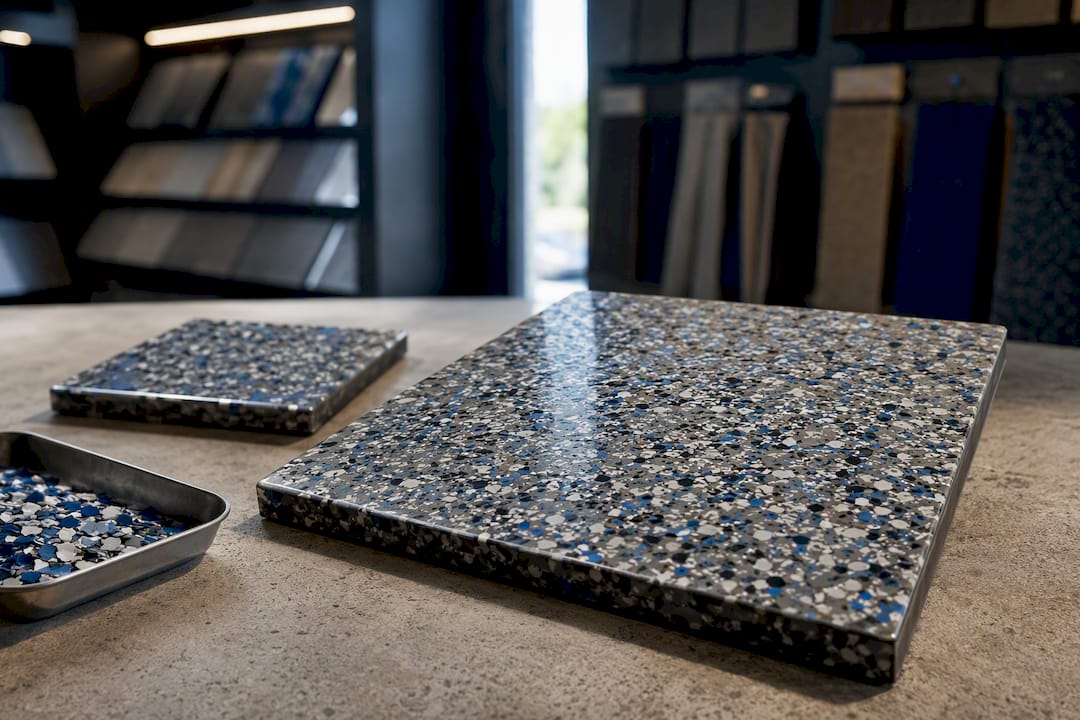
Loose flake chips in a bag look nothing like the same chips cured under a topcoat, so skipping this step is the most common regret homeowners report.
- Cure a sample board at least 12 by 12 inches, with the actual topcoat you plan to use over the flakes
- View it under the room's real lighting, not a showroom's fluorescent bulbs, since color reads differently once layered and sealed
- Compare at least two blend options side by side rather than judging one in isolation
Pre-blended bags guarantee consistency between installers and save time, while custom-mixed solid chips let you dial in a precise accent ratio the pre-mixed options don't offer.
Surface prep changes how a finished blend actually reads, and this is where a lot of DIY jobs go wrong before the flakes ever hit the floor. Diamond grinding is used on many projects rather than acid etching, because it opens the concrete's pore structure for a permanent mechanical bond and creates a flatter, more consistent surface for flakes to settle into evenly.
Pro Tip: Ask your installer to cure your sample board on a piece of prepped concrete, not a smooth tile or plastic sheet. Texture underneath changes how flakes settle and how light bounces off the final surface.
Flake Combinations Worth Copying
Here's a handful of ready-to-borrow pairings, each noting the base coat, flake size, and best setting.
- Charcoal, medium gray, white on a charcoal base with medium flakes: full broadcast garage classic.
- Tan, brown, cream on a mocha base with medium flakes: warm basement finish.
- Navy, slate gray, white on dark gray with fine flakes: coastal patio look.
- Black, white, red accent on black base with large flakes: high-visibility showroom statement.
- Silver, white, charcoal on medium gray with metallic accents: modern commercial entryway.
- Sand, terracotta, espresso on tan base with medium flakes: rustic rec room.
The bold and metallic options tend to be marketing-driven choices installers photograph often; the gray and earth-tone options are the low-maintenance workhorses most homeowners actually live with day to day. Build a sample board from two or three of these before deciding.
Durability and Upkeep Differences Between Blends
Color choice doesn't just affect looks. It changes how much maintenance a floor demands over its lifespan.
Darker, denser blends like charcoal and black hide oil stains, tire marks, and everyday grime far longer between cleanings than light or white-dominant blends. A pure white or cream floor in a garage will show every drip within days, while a gray-and-black blend can go weeks looking clean under identical use.
Bold, high-contrast blends can be trickier long-term. Bright reds and yellows are more prone to visible fading under UV exposure than neutral grays and browns, particularly in outdoor or sun-facing spaces without a UV-stable topcoat. Metallic accents generally hold their shimmer well but can show scratches more visibly than a matte, uniform blend, since scuffs catch light differently against the reflective flakes.
None of this means avoid bold colors. It means match your topcoat chemistry to the exposure level, and expect a lighter cleaning routine on darker blends versus a stricter one on white or pastel combinations.
How Lighting Changes the Way Flake Colors Read
The exact same blend can look completely different in a north-facing basement versus a garage with south-facing windows, and this catches a lot of homeowners off guard after installation.
Natural daylight tends to bring out true, saturated color and makes blues and earth tones look richer. Warm incandescent or yellow-toned LED lighting shifts everything toward the warm end, so grays can pick up a slightly beige cast and blues can look muddier than they did on the sample chip. Cool white LEDs, common in garages and commercial spaces, do the opposite and can make warm earth tones look washed out or flat.
This is exactly why a cured sample board matters more than a loose chip sample. Viewing your actual candidate blend under the room's real light source, at the time of day you'll use the space most, catches mismatches before they're permanent.
Flake Compatibility With Epoxy, Polyaspartic, and Polyurethane Systems
Not every flake blend behaves the same way under every topcoat, and the resin system you choose affects how long your colors stay true.
Standard epoxy topcoats are the most common and budget-friendly choice, but they're more prone to UV yellowing over time, which can shift white and light-colored blends toward an amber tint in sun-exposed areas. Polyaspartic topcoats cure faster and hold up better against UV exposure, making them a stronger match for patios, garages with big windows, or any blend where color accuracy over years matters. Polyurethane topcoats sit in between, offering strong abrasion resistance with a clarity that suits high-traffic commercial floors.
If you're set on a white, cream, or pastel blend, lean toward polyaspartic or a UV-stable formulation rather than standard epoxy, especially outdoors. Darker blends are more forgiving here since slight yellowing is far less noticeable against charcoal or black.
What's Trending in Flake Color Combinations Right Now
Full broadcast has become the default expectation on professional installs, largely because social media has trained homeowners to expect complete, seamless coverage rather than the visible-gap partial broadcasts common a decade ago.
Within that shift, neutral gray-scale blends remain the most requested option for garages and basements, but bold accent blends are gaining ground specifically because they photograph well for portfolio and marketing shots. Metallic accent flakes are showing up more often as a subtle upgrade added to an otherwise neutral blend, giving a floor visual depth without going fully bold. Earth tones continue holding steady in basements and finished living spaces where a warmer, less industrial feel is the goal.
Common Mistakes When Selecting Flake Color Combinations
Most flake color regrets trace back to a handful of repeatable mistakes.
Picking colors straight from a tiny loose chip sample without curing a board under the actual topcoat is the biggest one. Chips look different once layered, sealed, and lit under real conditions.
Mismatching the base coat to the dominant flake color is a close second, especially on partial broadcasts where every gap becomes a visible reminder of the mismatch. Choosing too many colors, past four, without a clear dominant tone, tends to produce a busy, chaotic floor instead of a cohesive one. And skipping proper diamond-grind surface prep in favor of a quick acid etch can leave flakes settling unevenly, distorting the blend's appearance even when the color choice itself was right.
An Installer's View on What Actually Holds Up
Diamond grinding, not acid etching, is what makes a blend look consistent five years in. Full broadcast has quietly become the standard we recommend on nearly every job, and neutral, mid-tone blends age better under real Missouri sun and salt than the boldest showroom picks.
— Stephen
Get a Sample Board and a Free Quote
Some installers skip the guesswork other installers leave you with. Instead of handing you a stack of loose chips and a color chart, some build cured sample boards under your actual topcoat so you see exactly how a blend will look on your floor before a single flake gets broadcast.

That means no surprises after installation, and no repainting a base coat because it clashed with the flakes on top of it. We handle diamond-grind prep on every job, offer the full range of flake color options for garages, basements, and patios, and turn most residential jobs around in a day or two. If you're weighing a basement floor or comparing garage coating options in Jefferson City or Columbia, reach out through our contact page for a free, no-pressure quote and a physical sample board built around the blend you're considering.
Where to See More Flake Colors and Blend Ideas
- Flake Color Palette: full manufacturer swatch collections for ordering sample chips.
- Blended Flake Color Chart: pre-mixed blends across multiple flake sizes.
- Custom garage styling ideas: decor pairings for finished garage spaces.
Sources
- Flake Epoxy Floor Colors & Custom Blend Ideas (2026 Guide) | ShowFloor AI
- Epoxy Flake Flooring: Complete Guide to Colors, Costs, and Installation - D and G Flooring
FAQ
What flake colors are available for epoxy floors?
Most manufacturers organize flake colors into families like gray-scale, earth tones, blue/coastal, bold multi-color, white/light, and metallic accents, each sold as individual solid chips or pre-blended mixes.
What are the most versatile blended flake colors?
Neutral gray blends combining medium gray, black, and white are the most versatile, since they suit garages, basements, and commercial floors while hiding dirt and matching almost any base coat.
What exactly are color flakes?
Color flakes, also called decorative chips, are small colored vinyl or paint pieces broadcast into a wet epoxy or polyaspartic base coat to create texture and pattern before the floor is sealed with a clear topcoat.
Does Showmeepoxy offer flake color sample boards?
Yes, Showmeepoxy builds cured sample boards under your chosen topcoat so you can see the true finished look before committing to a blend.