
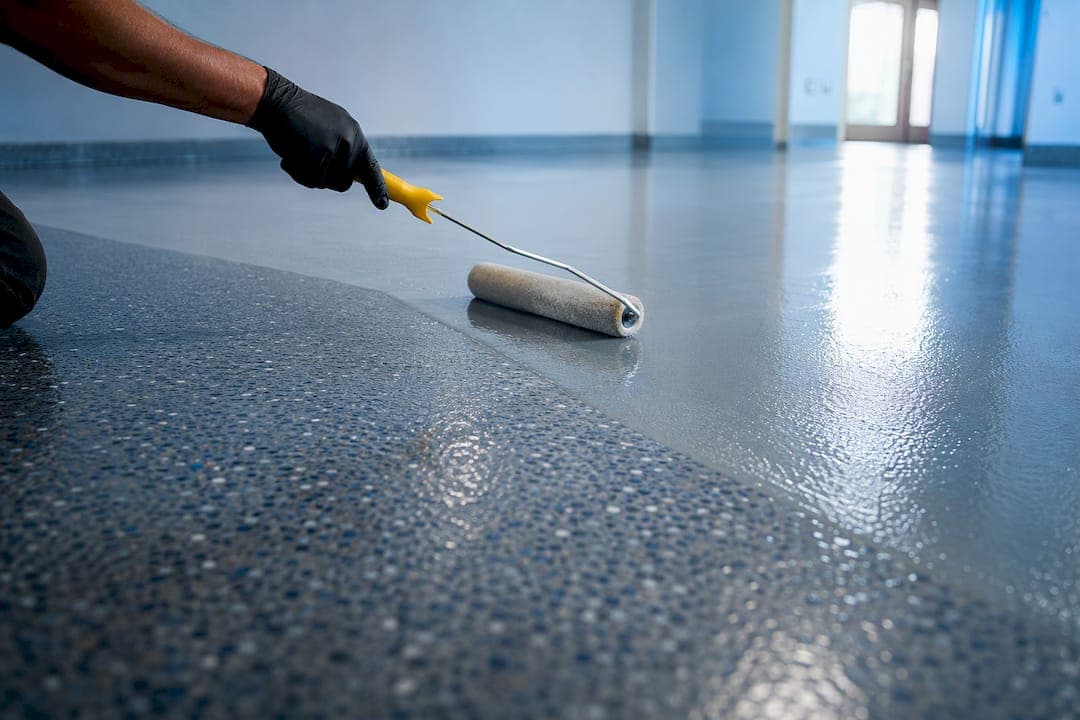
Epoxy wins on adhesion, film build, and chemical resistance, which makes it the right base for garage floors, basements, and deep-pour tabletops. Polyurethane wins on UV stability, abrasion resistance, and flexibility, which makes it the better topcoat and the smarter choice for anything that sits outdoors. For most real projects, the answer isn't either one. It's both, layered in the order pros use them.
TL;DR:
- Using epoxy as a base coat combined with a polyurethane topcoat offers both strong adhesion and UV resistance, ideal for outdoor or high-traffic surfaces.
- Epoxy provides superior chemical resistance and bond strength for interior floors, but it is prone to yellowing and cracking if exposed to direct sunlight or movement.
- Polyurethane excels in UV stability, abrasion resistance, and flexibility, making it best suited for outdoor decks, waterproofing, and surfaces exposed to temperature fluctuations.
- Proper surface preparation and moisture testing are critical for long-term durability, especially in moisture-prone areas like basements or slabs.
- Professional grinding, epoxy, and polyurethane application ensure optimal performance, especially for large or moisture-sensitive projects.
Table of Contents
- Epoxy vs Polyurethane at a Glance
- Why Do Epoxy and Polyurethane Behave So Differently?
- How Do UV Exposure, Abrasion, and Chemicals Affect Each Coating?
- Which Should You Use for Floors, Waterproofing, Woodworking, and Bar Tops?
- What Trips People Up During Installation?
- How Pros Combine Epoxy and Polyurethane for a Permanent Bond
- A Straight Answer for Homeowners Weighing Their Options
- Get a Professional Epoxy System Done Right the First Time
- Sources
Epoxy vs Polyurethane at a Glance
Here's how the two stack up across the properties that actually decide a project's outcome.
| Property | Epoxy | Polyurethane |
|---|---|---|
| Adhesion / build thickness | Excellent, high film build | Good, thinner films |
| UV stability | Poor, yellows without a topcoat | Strong, especially aliphatic types |
| Abrasion & scratch resistance | Moderate | Better, more elastic recovery |
| Flexibility / crack bridging | Rigid | Flexible, bridges movement |
| Chemical resistance | Excellent (oils, solvents) | Good, but epoxy edges it out |
| Cure time / pot life | Longer pot life, slower full cure | Faster recoat windows, moisture-sensitive |
| Cost & longevity | Lower material cost, shorter outdoor life | Higher cost, longer life outdoors |
Choose epoxy alone for a covered garage or basement floor with no direct sun. Choose polyurethane alone for a waterproofing membrane on a deck that flexes with temperature swings. Combine them, epoxy base plus polyurethane topcoat, for anywhere you want both a permanent bond and a finish that won't scratch, chalk, or amber. That yellowing everyone associates with epoxy garage floors is cosmetic, not structural, and a UV-stable polyurethane topcoat prevents it entirely.
Why Do Epoxy and Polyurethane Behave So Differently?
Epoxy cures through a chemical reaction that crosslinks epoxide groups into a dense, rigid polymer network. That crosslinking is what gives epoxy its aggressive bond to concrete and its resistance to solvents, oils, and abrasion from chemicals rather than foot traffic. The tighter the crosslink density, the harder and more chemically stubborn the film becomes, a relationship laid out clearly in materials-science research on epoxy chemistry.
Polyurethane forms through a different reaction entirely, isocyanates bonding with polyols, and the resulting polymer keeps more chain mobility even after it cures. That mobility is exactly why polyurethane stays flexible instead of turning glass hard. Aliphatic polyurethanes, the type used in quality topcoats, also resist UV breakdown far better than epoxy's aromatic backbone, which is prone to photo-oxidation and ambering.
That chemistry difference shows up the moment concrete moves. Slabs expand, contract, and hairline-crack with temperature and moisture cycles. A rigid epoxy film sitting directly over a moving crack will crack with it. A flexible polyurethane layer can stretch slightly and bridge that same movement without splitting. This is the real reason coating systems put a hard epoxy for build and bond underneath a flexible polyurethane for surface performance, not marketing, just physics doing what each polymer is built to do.
How Do UV Exposure, Abrasion, and Chemicals Affect Each Coating?
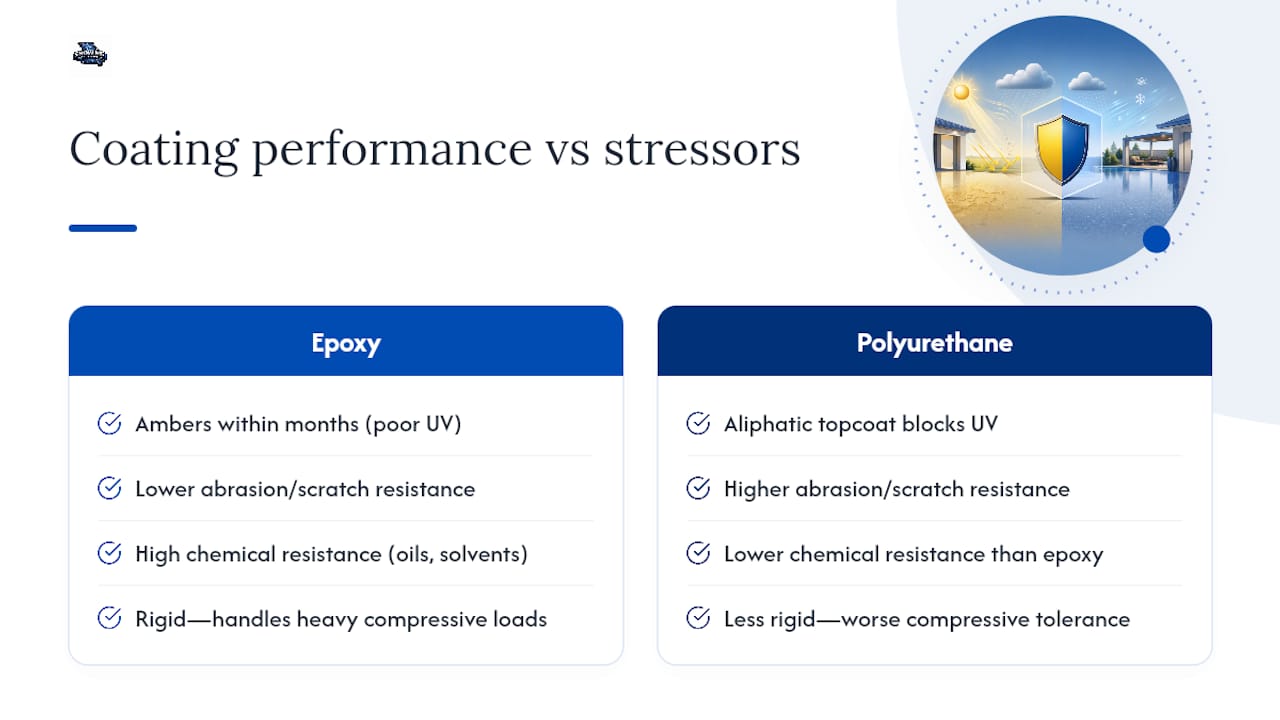
UV stability. Unprotected epoxy ambers within months of direct sun exposure because its aromatic rings absorb UV energy and break down. An aliphatic polyurethane topcoat blocks that UV before it reaches the epoxy, which is why outdoor and window-heavy spaces almost always need one.
Abrasion and scratch resistance. Polyurethane typically outlasts epoxy under foot traffic, pet claws, and dragged furniture because its elasticity lets the surface flex and recover instead of scoring. Buyer guides comparing the two resins consistently rank polyurethane ahead on wear resistance for exactly this reason.
Chemical resistance and load tolerance. Epoxy still leads here. It shrugs off motor oil, brake fluid, gasoline, and industrial solvents better than most polyurethanes, and its rigidity handles heavy compressive loads, jack stands, tool chests, forklifts, without denting.
Impact, vibration, and thermal movement. Anywhere a substrate flexes or vibrates, from wood-framed decks to slabs near expansion joints, polyurethane's give prevents the cracking that a rigid epoxy film can't absorb.
Which Should You Use for Floors, Waterproofing, Woodworking, and Bar Tops?
The right material depends entirely on what the surface has to survive, not just what it looks like on day one.
- Garage and commercial floors. An epoxy base coat plus a polyurethane topcoat is the standard for a reason: you get epoxy's bond strength and film build under polyurethane's scratch and UV resistance. Epoxy alone can work in a covered, low-sun interior space, but skip it for any floor near a garage door or big windows.
- Outdoor waterproofing and decks. Favor polyurethane, or polyurethane over an epoxy primer. Outdoor surfaces need flexibility to survive freeze-thaw cycles and UV resistance to avoid degrading within a season.
- Woodworking and bar tops. Epoxy is the right call for deep pours, river tables, and anything needing crystal clarity, since it has the working time and depth capacity polyurethane lacks. A polyurethane finish coat over the cured epoxy then adds the scratch and UV protection a bar top takes daily abuse from.
- Basements and moisture-prone areas. Surface prep and a moisture test come before any material decision. Vapor coming up through a slab will delaminate the best coating on the market.
Pro Tip: If you're on the fence about a basement, get a moisture test before you buy a single gallon of anything. It's a five-minute check that prevents a floor failure six months later.
What Trips People Up During Installation?
Pot life and recoat windows are where DIY projects most often go wrong. Epoxy generally gives you a longer working window but a slower full cure, while polyurethane recoats faster but reacts badly to humidity during application.
- Grind or shot-blast the concrete first; painting over a smooth or contaminated slab is the number one cause of peeling.
- Run a moisture test on any basement or slab-on-grade pour before committing to epoxy.
- Watch humidity and temperature closely with moisture-cure polyurethanes. High RH during application can trigger bubbling or a cloudy finish.
- Schedule coats for dry, moderate-temperature days, and never rush a recoat window just to finish a weekend project.
Most "epoxy failed" complaints trace back to skipped prep, not the material itself. That's true of polyurethane too. You can learn more about how prep affects long-term durability before deciding whether to tackle a floor yourself.
How Pros Combine Epoxy and Polyurethane for a Permanent Bond
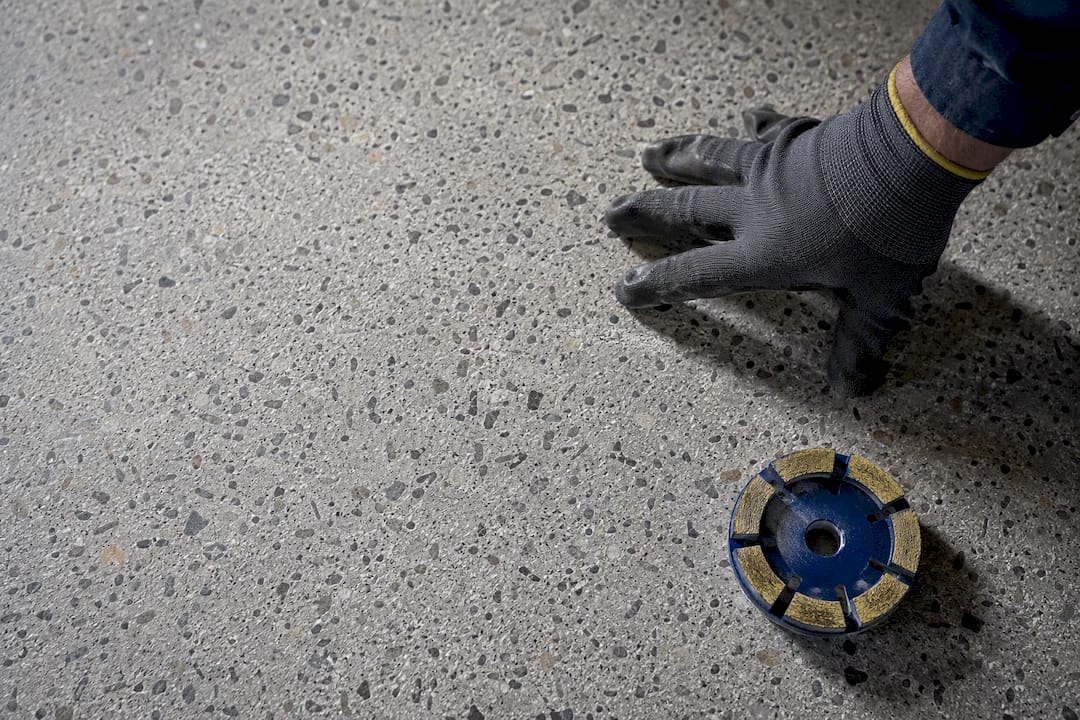
Diamond grinding is what separates a floor that lasts decades from one that peels in two years. Grinding opens the concrete's pores mechanically, giving epoxy a mechanical key to grip instead of a smooth surface it can only sit on top of. Showmeepoxy builds every job on this prep step before a drop of material goes down, a practice detailed further in this comparison of grinding versus other prep methods.
The standard professional system runs three coats: an epoxy primer to lock into ground concrete, an epoxy build coat for thickness and chemical resistance, then an aliphatic polyurethane topcoat for UV stability and scratch resistance. Done correctly, that system is built to handle real garage and commercial conditions for years with minimal upkeep beyond routine cleaning.
A Straight Answer for Homeowners Weighing Their Options
For a typical garage floor or any outdoor-facing surface, my default recommendation is the combined system: epoxy underneath, polyurethane on top. It's not the cheapest option on paper, but it's the one that avoids yellowing, scratching, and premature wear, which is what actually costs you money down the line.
DIY makes sense for small, simple pours. Call a pro once you're dealing with moisture issues, cracked or uneven substrate, a deep pour, or anything larger than a single-car garage. Getting a quote costs nothing, and a no-pressure consultation will tell you fast whether your project is a weekend job or one that needs a grinder and a crew.
— Stephen
Get a Professional Epoxy System Done Right the First Time
Grinding it yourself with a rented machine, buying separate epoxy and polyurethane kits, and hoping the timing lines up is one path. Hiring it out done right the first time is another, and it's the one that skips the guesswork on humidity, recoat windows, and whether your slab even needs a moisture test before anything gets applied.

Showmeepoxy installs the same three-coat system covered above, diamond-ground prep, epoxy build, aliphatic polyurethane topcoat, on garages, basements, and commercial floors across Mid-Missouri, with quick turnaround and honest, no-pressure pricing. If your basement deals with moisture, our basement epoxy flooring service starts with the same testing steps outlined above. For anything else, from a single garage bay to a full commercial space, request a free quote and find out what a permanent bond actually looks like.
Sources
- Epoxy overview (materials science) — University of North Texas
- Epoxy vs Polyurethane floor: Key differences, cost & best uses (2026) - D and G Flooring
- Polyurethane resin vs Epoxy resin buyer guide — RW Atelier