
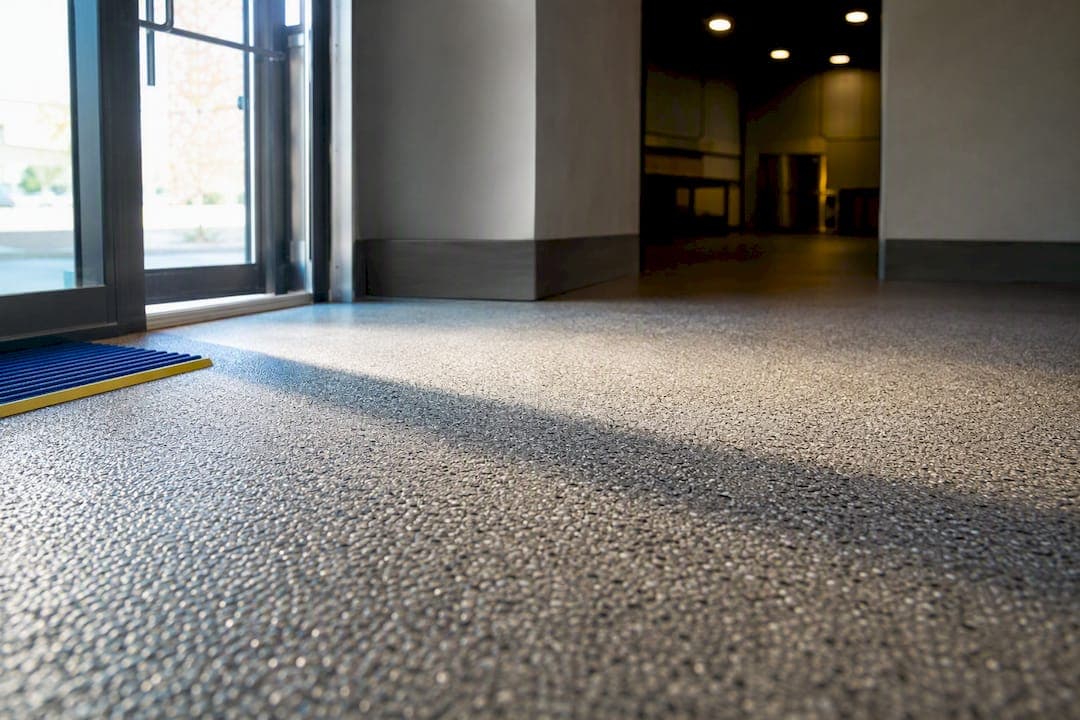
Quartz epoxy flooring is a broadcast system that embeds colored quartz aggregate into a pigmented epoxy base coat, then seals it with a clear topcoat for a durable, decorative surface. It resists chemicals, abrasion, and heavy foot or wheel traffic far better than paint or sealed concrete. It also requires real surface preparation and correct installation to perform. The right system depends heavily on your traffic type, moisture conditions, and whether you need slip resistance or UV stability.
TL;DR:
- Proper surface preparation through diamond grinding and actual moisture testing are essential to prevent early epoxy floor failures.
- Full quartz epoxy systems typically range from 3/16 to 3/8 inch thick, with aggregate size influencing slip resistance and surface smoothness.
- Expect installation to take several days, with a cure time of four to five days before the floor is fully functional.
- Regular maintenance involves neutral pH cleaning, with recoat intervals ranging from two to eight years depending on usage.
- Contractors should provide detailed system specs, including moisture test results and film thickness, to ensure proper durability.
Table of Contents
- What Is Quartz Epoxy Flooring, and Where Is It Used?
- System Build-Up: Layers, Thickness, and Topcoat Choices
- Performance: Durability, Slip Resistance, and Real Tradeoffs
- Installation: Surface Prep, Moisture Testing, Timeline, and Cost
- Maintenance, Cleaning, and Recoating Schedule
- How to Choose the Right Quartz Epoxy Spec or Contractor
- Showmeepoxy's Approach to Quartz Epoxy Installation
- When Quartz Epoxy Makes Sense, and When It Doesn't
- Get a Quote Built Around Real Surface Prep
- Sources
What Is Quartz Epoxy Flooring, and Where Is It Used?
The industry term is quartz broadcast flooring, and the process is straightforward in concept even though the execution takes skill. An installer applies a pigmented epoxy base coat, then broadcasts colored quartz aggregate into it while it's still wet, building texture and visual depth you can't get from a flat coating. The quartz itself is chosen for hardness and color range, and finer or coarser aggregate blends let installers dial in traction control for wet or dry environments.
You'll find quartz epoxy flooring in:
- Commercial kitchens and restrooms, where hygiene and slip resistance matter most
- Retail showrooms and lobbies, where the decorative finish carries visual weight
- Garages and basements, where durability and stain resistance beat bare concrete
- Light industrial areas, where chemical spills and rolling loads are routine
This is the "decorative, durable" middle ground between an economy epoxy paint and a heavy-duty industrial coating.
System Build-Up: Layers, Thickness, and Topcoat Choices
A proper quartz epoxy flooring system isn't one product. It's a stack of layers, each doing a specific job:
- Primer — penetrates and bonds to the prepared concrete substrate
- Pigmented epoxy base coat — carries the color and holds the broadcast aggregate
- Quartz broadcast — applied to refusal, meaning aggregate is added until the surface can't absorb anymore
- Clear topcoat — usually one or two coats, sealing the aggregate and providing wear resistance
Full decorative broadcast systems typically have a thickness in the range commonly used for such applications, while troweled quartz mortar systems built for heavier wear often specify a thinner 1/8 to 1/4 inch nominal thickness with denser aggregate packing. Most complete installations typically consist of multiple distinct layers from primer through final topcoat, and each layer's coverage rate should match manufacturer technical data rather than a contractor's guess. Urethane topcoats get chosen over standard epoxy topcoats specifically for UV resistance, since epoxy yellows with sun exposure. Aggregate size also drives final texture: finer quartz gives a smoother, easier-to-clean surface, while coarser blends add grip at the cost of a rougher feel underfoot.
Performance: Durability, Slip Resistance, and Real Tradeoffs
Properly installed, decorative broadcast systems can provide a long service life in commercial settings, according to maintenance and installation data from Opora Supply. That figure assumes correct prep and a maintenance program that doesn't cut corners on cleaning chemistry.
Statistic to know: decorative quartz broadcast systems generally run 3/16 to 3/8 inch thick in full-broadcast configurations, and that thickness is a major reason they outlast thin single-coat epoxy paints, which wear through in a fraction of the time.
The advantages and limitations both matter when you're deciding whether this system fits your space:
- Durability: resists abrasion, impact, and most chemical spills once fully cured
- Slip resistance: tunable through aggregate size, though wet commercial kitchens still need a coarser blend and a matte topcoat
- Chemical resistance: handles oil, cleaning agents, and light acids better than sealed concrete
- UV sensitivity: standard epoxy yellows outdoors, so exterior applications need a urethane or polyaspartic topcoat
- Cost and downtime: professional installation runs several days, and the floor is unusable during cure
- Hardness underfoot: a rigid quartz epoxy floor doesn't have the give of vinyl or rubber flooring options, which matters for staff standing all day
Installation: Surface Prep, Moisture Testing, Timeline, and Cost
Most quartz epoxy flooring failures trace back to two things: skipped moisture testing and inadequate mechanical prep. Diamond grinding or shotblasting opens the concrete's pore structure to a specified profile, which is what allows the epoxy to form a permanent mechanical bond instead of just sitting on the surface. Skip this step, and you're setting up delamination within a year or two, according to Opora Supply's field guide on epoxy failure modes.
Moisture testing follows the ASTM F1869 calcium chloride method, which measures vapor emission from the slab. Readings above roughly 3 pounds per 1,000 square feet per 24 hours typically call for a moisture mitigation step before coating, or the epoxy can blister and fail from underneath.
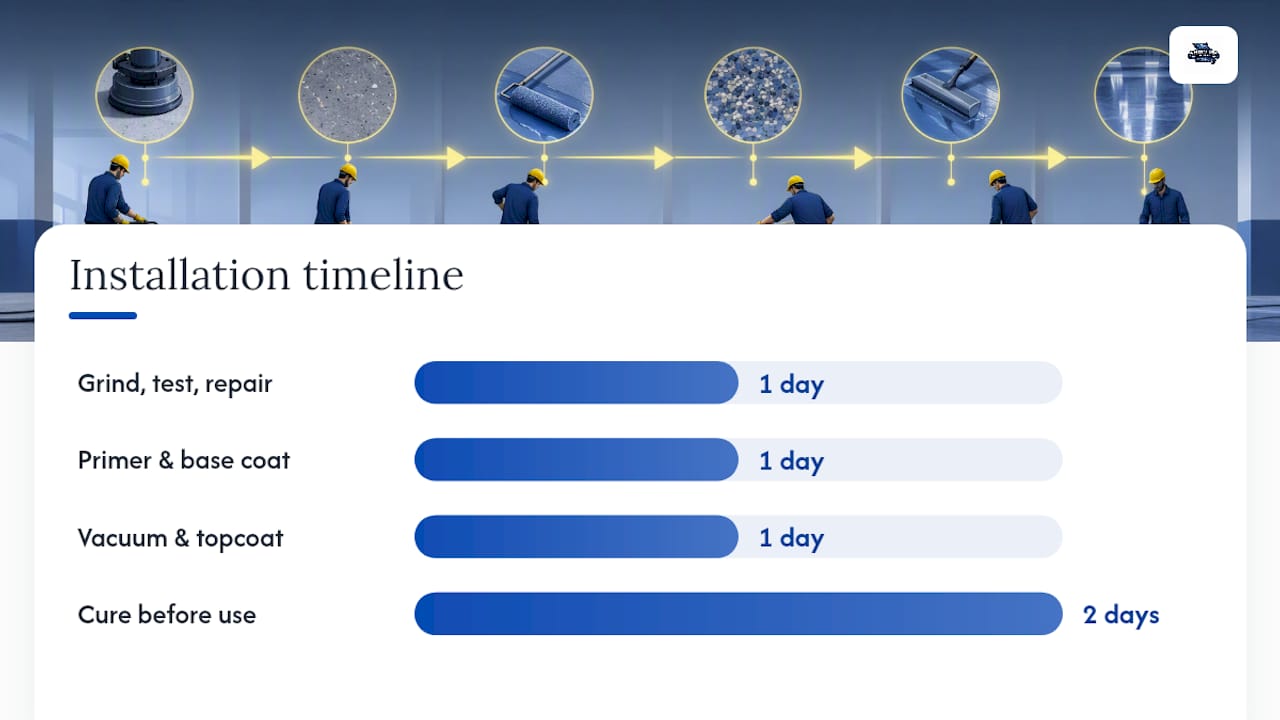
A typical installation runs in phases:
- Day 1: diamond grinding, moisture testing, crack repair
- Day 2: primer and base coat application, quartz broadcast to refusal
- Day 3: vacuum excess aggregate, apply topcoat(s)
- Day 4 to 5: cure time before foot traffic and full vehicle load
Pro Tip: Ask for the actual moisture test numbers in writing, not just a verbal "it's fine." A contractor who can't produce ASTM F1869 readings is skipping a step that determines whether your floor lasts five years or fifteen.
Cost drivers include prep intensity (grinding versus shotblasting), moisture mitigation needs, decorative complexity (multi-color blends cost more than single-color broadcast), and total square footage. Homeowners researching a garage epoxy project's actual cost will find prep and moisture conditions swing the price more than the epoxy itself.
Maintenance, Cleaning, and Recoating Schedule
Daily maintenance is simple: dust mop or use a soft-bristle scrubber with a neutral pH cleaner between 6 and 9, according to Permagard's epoxy maintenance guide. High-pH cleaners, solvents, and abrasive scrub pads etch and dull the topcoat over time, which is the most common maintenance mistake commercial facilities make.
| Use case | Cleaning frequency | Recoat interval |
|---|---|---|
| Light residential (garage, basement) | Weekly sweep, monthly mop | 8 years |
| Retail or showroom | Daily dust mop, weekly wet clean | 5 years |
| Commercial kitchen or industrial | Daily scrub with pH-neutral cleaner | 2 to 4 years |
Recoat timing tracks with visible wear: dulling in the topcoat, aggregate showing through, or reduced slip resistance in wet-traffic zones. A routine garage floor maintenance schedule that catches wear early usually means a simple recoat rather than a full strip-and-redo.
How to Choose the Right Quartz Epoxy Spec or Contractor
Matching the system to your space starts before you sign anything:
- Identify traffic type — foot traffic only, or forklifts and rolling carts
- Confirm wet or dry exposure — commercial kitchens and locker rooms need coarser aggregate and matte topcoats
- Ask for moisture test numbers — not a promise, actual ASTM F1869 readings
- Get mil thickness in writing — vague answers like "a good coat" are a red flag
- Ask about the warranty and maintenance expectations — a real warranty comes with real prep documentation
Watch for red flags: no mechanical prep mentioned, no moisture testing offered, unrealistic same-day cure claims, or a bid dramatically under every other quote you've collected. If you're vetting a local installer, checking how a regional flooring contractor describes flake and metallic finish options is a useful benchmark for what a proper proposal should include.
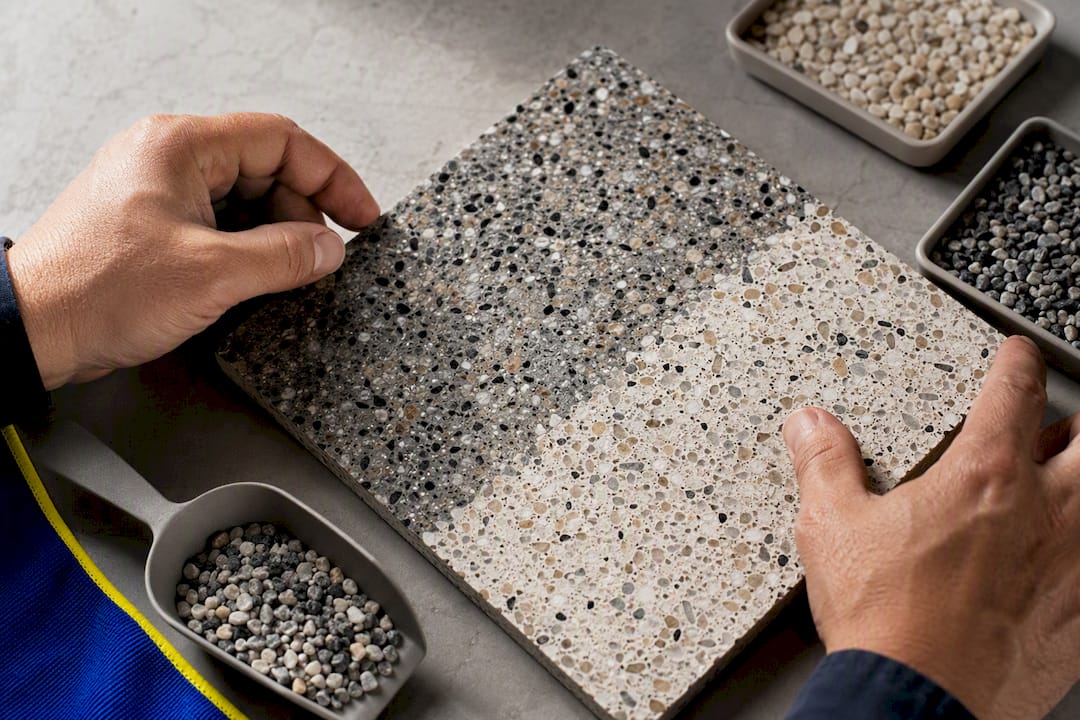
Pro Tip: Ask to see the aggregate blend and a sample board before installation, not after. Color and texture look different on a 12 inch sample than across 1,000 square feet of finished floor.
Showmeepoxy's Approach to Quartz Epoxy Installation
Showmeepoxy builds every project around diamond-grinding surface prep first, because a mechanically profiled substrate is what makes the epoxy bond permanent rather than just adhesive. That single step is where most competing installations cut corners, and it's where floors fail. Industrial-grade epoxy and polyaspartic materials go over that prepared surface.
When Quartz Epoxy Makes Sense, and When It Doesn't
Quartz epoxy flooring earns its reputation in hygienic commercial spaces, decorative garages, and showroom floors where you want durability and visual polish in one system. Those are the projects where the investment pays off fastest.
It's a weaker fit outdoors under constant UV exposure without a urethane topcoat, or on slabs with active joint movement that hasn't been addressed first. Skip the mechanical prep or the joint treatment, and no topcoat will save the installation.
— Stephen
Get a Quote Built Around Real Surface Prep
Showmeepoxy is the alternative to guesswork installers who skip the steps that actually determine how long a floor lasts. A typical quote includes diamond-grinding prep, a real moisture test, a written system spec with mil thickness, and a realistic installation timeline, not a vague promise.

Scheduling starts with a walkthrough of your space, whether it's a garage, basement, or commercial floor, followed by a written proposal you can actually compare against other bids. Most residential jobs move from consultation to finished floor within days, not weeks, because the prep work is planned upfront instead of discovered mid-project. If you're weighing a basement installation specifically, Showmeepoxy's basement epoxy flooring service covers moisture mitigation as part of the standard scope. Ready to see what a proper spec looks like for your space? Request your free quote and get a proposal built on diamond grinding, not shortcuts.
Sources
- Epoxy-Coated Concrete Floor Care Playbook – Opora Supply
- Sikafloor® DecoDur Quartz TG
- Epoxy Floor Maintenance - The Complete Guide | Permagard