
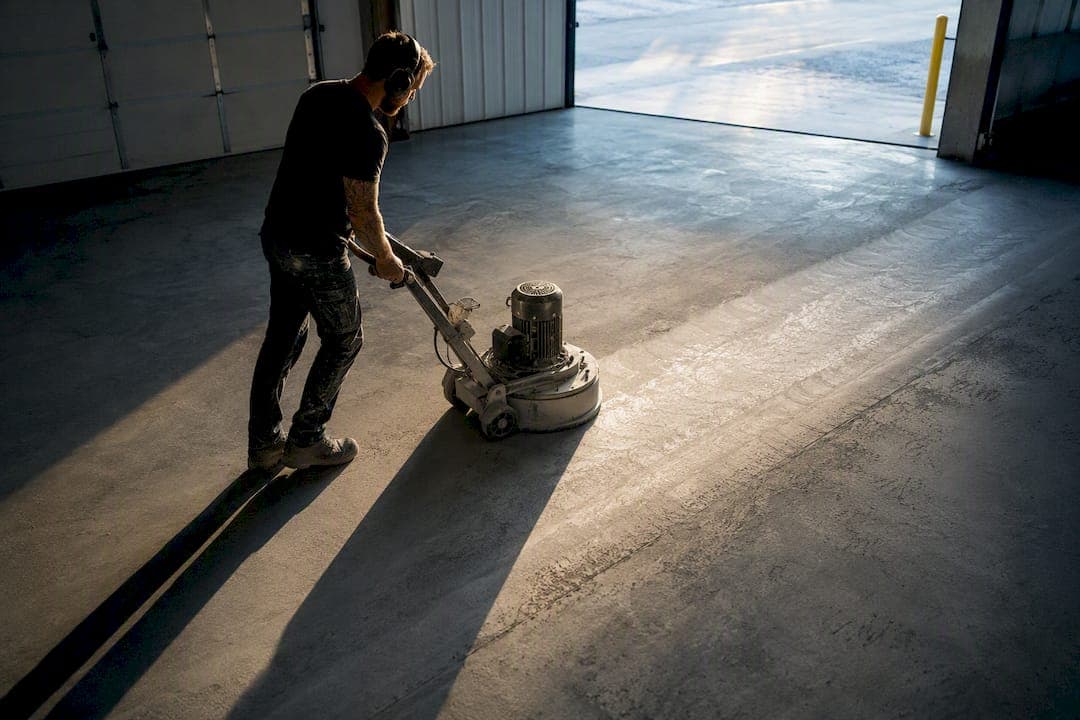
Epoxy can absolutely be made slip resistant, but only when it's specified and installed as a true textured system, not a plain glossy pour. Installers create traction two main ways: broadcasting graded aggregate into wet epoxy, or using high-build textured epoxy formulated with grit already mixed in. Which method wins comes down to surface prep, especially diamond grinding, and picking the right aggregate gradation for the space.
TL;DR:
- Properly applied textured epoxy systems rely on diamond grinding to ensure a strong bond and prevent delamination over time.
- Broadcast aggregate type and rate determine the aggressiveness of the slip resistance, with calcined bauxite offering the highest abrasion resistance.
- Selecting the right epoxy chemistry, such as 100% solids or solvent-free formulations, impacts durability and resistance in high-traffic or chemical-exposed environments.
- Regular mechanical cleaning with neutral detergents is essential to maintain traction by preventing grime buildup within the textured surface.
- Accurate substrate preparation, including thorough surface repair and dust removal, is critical for long-lasting slip-resistant epoxy floors.
Table of Contents
- How Slip-Resistant Epoxy Systems Actually Work
- Types of Aggregates and Texture Levels: Choosing the Right Profile
- Where Slip-Resistant Epoxy Makes the Most Sense
- Preparing the Substrate: Why Diamond Grinding Comes First
- How Do You Test and Specify Slip Resistance?
- Maintenance Practices That Preserve Traction Over Time
- What Does a Slip-Resistant Epoxy Project Actually Cost?
- Common Mistakes and Practitioner Pro Tips
- Does Slip-Resistant Epoxy Work on Every Substrate?
- An Installer's View on What Actually Makes These Floors Last
- Get a Slip-Resistant Epoxy Floor Installed Right the First Time
- Where to Learn More About Slip-Resistant Epoxy Specs
- Sources
- FAQ
How Slip-Resistant Epoxy Systems Actually Work
Every anti-slip epoxy coating relies on the same basic principle: a resin binder holds a textured particle in place, and that particle breaks up an otherwise smooth surface just enough to give a shoe, tire, or forklift wheel something to grip. The most common method is the broadcast aggregate technique, where installers spread graded grit, often calcined bauxite or silica sand, directly into a wet base coat of epoxy resin. The resin cures around the particles, locking them in permanently rather than gluing them on top where they'd wear away in a season.
The chemistry of the base epoxy matters just as much as the aggregate on top of it. 100% solids epoxy systems cure into a thick, hard film with almost no shrinkage, which is why high build epoxy formulations hold up under heavy foot and vehicle traffic without losing their texture prematurely. Waterborne epoxies go on thinner and lower odor, which suits occupied buildings, but they generally wear faster under the same load. Solvent-free formulations split the difference: lower VOC output during application, plus a build thick enough to anchor aggregate for years rather than months.
A few things determine how a given system will actually perform once cured:
- Binder thickness (film build): thicker coats hold larger aggregate particles more securely and resist wear longer.
- Aggregate hardness: harder minerals like aluminum oxide resist rounding off under repeated abrasion.
- Cure chemistry: fast-curing 100% solids systems reduce downtime but demand tighter control over ambient temperature during application.
- Bond quality to the slab: no formulation compensates for a poorly prepared substrate underneath it.
That last point is the one installers care about most, because a beautiful textured topcoat over a poorly bonded base coat is a floor that delaminates in patches within a year or two.
Types of Aggregates and Texture Levels: Choosing the Right Profile
Not every environment needs the same bite. A home garage floor doesn't need the same aggressive grit as a meat processing plant, and picking the wrong texture level creates either a floor that's still too slick or one that's a nightmare to keep clean.
The three aggregates you'll see most often each have a distinct feel underfoot:
- Calcined bauxite: extremely hard, angular, and holds its edge under abrasion, making it a common choice in industrial-grade slip-resistant epoxy systems exposed to forklifts and pallet jacks.
- Aluminum oxide: slightly less aggressive than bauxite, popular where a firm grip is needed without the coarser feel underfoot.
- Silica/quartz sand: more affordable and rounder, giving a moderate texture suited to light commercial and residential floors.
Broadcast rate controls how rough the final surface feels. A light dusting produces a subtle texture appropriate for a showroom or retail floor; a full broadcast to rejection, where aggregate is spread until the resin can't absorb anymore, produces the aggressive grip needed for a loading dock or a wet processing area. As a rough guide, professionals adjust rates depending on desired roughness rather than applying one universal number to every job, since gradation and particle size shift the outcome as much as the amount used.
Pro Tip: If your space sees both bare feet and rolling equipment, like a garage that doubles as a workshop, ask your installer about an intermediate broadcast profile. It's rough enough for grip but doesn't turn into a knuckle scraper if you're kneeling on it.
The trade-off is consistent across every project: more aggregate means more grip and more cleaning effort. A heavily textured floor traps grime, dust, and standing water in its peaks and valleys, so the aggressive end of the spectrum should be reserved for spaces where safety outranks ease of mopping.
Where Slip-Resistant Epoxy Makes the Most Sense
Different spaces need different levels of traction, and matching the system to the environment is where most specification mistakes happen. A garage floor doesn't need the same chemical resistance as a commercial kitchen, and a wet processing bay has entirely different demands than a pedestrian ramp.
Here's how use cases typically map to system choice:
- Residential garages: moderate broadcast rate, focused on wet-tire and oil-spill traction rather than heavy chemical exposure.
- Commercial kitchens and food processing: fine-to-medium aggregate with strong chemical and grease resistance, since hygiene standards often restrict porous or hard-to-clean finishes.
- Ramps and inclines: aggressive broadcast profiles, since gravity adds momentum that flat floors don't have to counteract.
- Industrial bays with forklift traffic: heavy-duty, high-build systems rated for point loads and constant abrasion.
Chemical exposure changes the calculus too. A floor that only sees foot traffic and the occasional car tire can run a lighter system than one exposed to de-icing salt, hydraulic fluid, or cleaning acids daily. Food-safety environments add another layer: the coating itself often needs to meet sanitation requirements on top of slip resistance, which narrows the list of acceptable formulations considerably.
Preparing the Substrate: Why Diamond Grinding Comes First
Surface prep decides whether an anti-slip epoxy floor lasts five years or fifteen, and diamond grinding is the method that consistently outperforms acid etching or light shot-blasting for permanent bonding. Grinding mechanically opens the concrete's pores, exposing fresh aggregate at the surface, and it levels high spots that would otherwise create thin, weak zones in the coating. Acid etching only cleans the surface chemically. It doesn't create the mechanical profile that lets a coating grip the slab the way ground concrete does, and that difference shows up years later as peeling and flaking.
The installation sequence generally follows this order:
- Repair the concrete. Cracks, spalling, and pits get patched before anything else touches the floor.
- Diamond grind the entire surface. This opens the pores and levels the profile so aggregate settles evenly across the whole floor rather than pooling in low spots.
- Vacuum and inspect. Dust removal matters here more than people expect. Leftover grinding dust is one of the most common causes of bond failure.
- Apply a primer or base coat. This penetrates the ground concrete and seals it before the textured layer goes down.
- Broadcast aggregate or apply the textured coat. Timing matters. The aggregate needs to go into the base coat while it's still wet enough to accept it.
- Apply the sealer or topcoat. This locks the aggregate in place and determines the final feel and cleanability of the floor.
Cure times vary by product and temperature, but many 100% solids systems allow light foot traffic within a day and full vehicle traffic within approximately a week, assuming ambient temperatures stay in the manufacturer's recommended range. Cold slabs or high humidity slow that timeline considerably, which is why pot life and application windows listed on a technical data sheet aren't just fine print. Rushing a recoat before the previous layer has properly cured is one of the fastest ways to end up with a floor that looks fine on day one and delaminates by month six.
Pro Tip: Ask your installer for the technical data sheet's recoat window in writing before the project starts, not just verbally on-site. Ambient temperature swings between morning and afternoon can shrink that window by hours.
How Do You Test and Specify Slip Resistance?
Slip resistance gets measured through coefficient of friction, or COF, which quantifies how much resistance a surface offers against sliding, tested in both static (standing) and dynamic (walking, wet) conditions. Rather than chasing a specific product name, the smarter move is to specify a performance outcome, a target COF range or a documented low slip potential classification, and let installers and manufacturers show how their system meets it.
At handover, ask for documentation that actually proves performance rather than taking a sales sheet at its word:
- Manufacturer lab reports showing tested COF values for the specific product and aggregate combination used.
- A written broadcast rate and aggregate type used on your job, not just the generic product literature.
- Photos or a walk-through of the finished texture before the topcoat locks it in.
Most installers won't hand over this paperwork unless you ask for it upfront, and by the time a floor feels slippery six months in, there's no way to verify whether the original spec was ever actually met.
Maintenance Practices That Preserve Traction Over Time
A textured epoxy floor loses its grip the same way a tire loses tread: gradually, through wear and buildup, until one day it's noticeably worse. The biggest culprit isn't the epoxy breaking down. It's grime and residue filling in the texture that was supposed to provide traction in the first place.
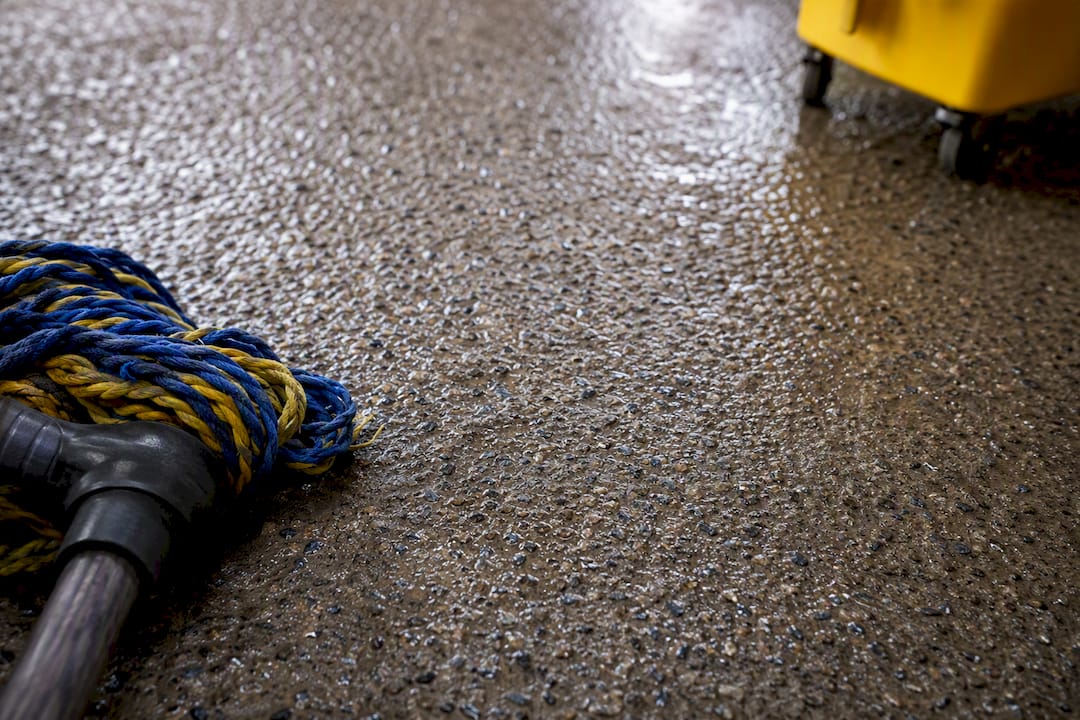
Mechanical scrubbing beats mopping every time on a textured surface, since a mop glides over peaks and leaves grime packed into the valleys. Low-residue, pH-neutral detergents work better than heavy degreasers or anything waxy, because waxy residue builds up in the texture and effectively fills in the grip you paid for.
A rough maintenance rhythm by site type looks like this:
- Garages: monthly mechanical sweep, quarterly wet scrub.
- Commercial kitchens: daily mechanical cleaning given grease exposure, given how quickly oils fill fine texture.
- Warehouses: weekly sweeping, monthly scrubbing depending on dust and forklift traffic load.
Facilities managing high-traffic grime buildup can lean on specialized cleaning guidance for the mechanical scrubbing techniques that actually lift embedded soil rather than just pushing it around.
What Does a Slip-Resistant Epoxy Project Actually Cost?
Coverage rates depend heavily on film build and how much aggregate goes into the mix. A standard base coat typically runs somewhere in the range manufacturers list per gallon on their technical data sheets, and heavier broadcast rates for aggressive texture reduce that coverage since more material gets absorbed into the aggregate layer.
Here's what actually drives the budget on most projects:
- Labor and prep, not the epoxy itself, account for the majority of project cost, since diamond grinding and concrete repair take real time regardless of which coating goes on top.
- Moisture mitigation in basements or slab-on-grade floors adds both cost and days to a timeline if testing reveals vapor issues.
- Cure and traffic timelines generally allow foot traffic within a day and full vehicle traffic within about a week, weather permitting.
Rushed timelines almost always cost more later in repairs than they save upfront.
Common Mistakes and Practitioner Pro Tips
The most common failure is skipping diamond grinding to save a day of labor, which shortens the floor's life dramatically. Uneven broadcast, overworking the wet coating with a roller, and using an aggregate too coarse or too fine for the space round out the usual list of problems.
- Test a small patch first to check both texture feel and how easily it wipes clean.
- Broadcast in stages rather than all at once, which keeps particle distribution even instead of clumping in some spots and thin in others.
- Follow the product's listed pot life and roller technique exactly. Improvising here is where uniformity breaks down.
Pro Tip: If a contractor can't tell you their broadcast rate or aggregate type off the top of their head, that's a signal to ask more questions before signing.
Does Slip-Resistant Epoxy Work on Every Substrate?
Slip-resistant epoxy bonds reliably to properly prepared concrete, which remains the gold standard substrate because it's porous enough to accept mechanical grinding and absorb primer. Most garage, warehouse, and commercial floor projects start here, and it's the substrate every major aggregate and epoxy system on the market is formulated to work with.
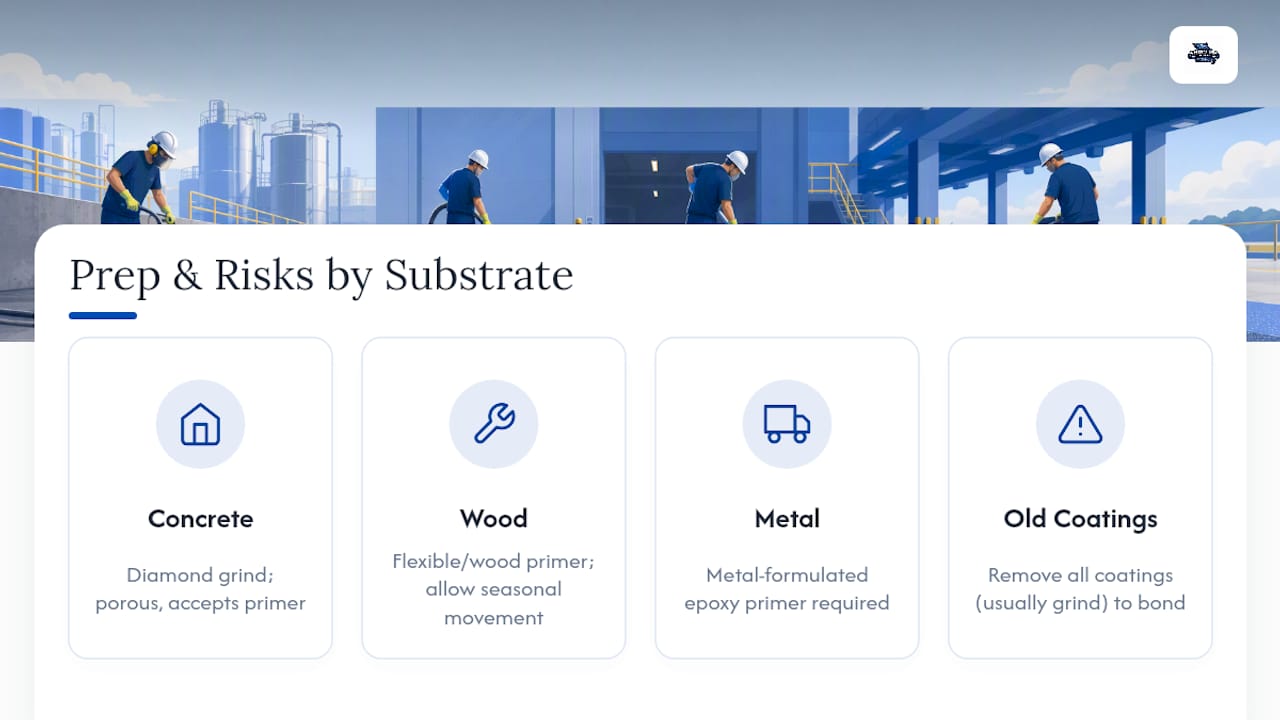
Wood subfloors and plywood decking can accept epoxy coatings, but they need a different prep approach since diamond grinding isn't an option on wood. Installers typically use a specialized primer designed for flexible or wood substrates, and the coating needs some tolerance for minor seasonal movement that concrete doesn't experience.
Metal decking, common in some industrial mezzanines and ramps, requires an epoxy primer formulated for metal adhesion rather than the concrete-specific primers used elsewhere. Skipping that substitution is a common reason metal-deck coatings peel prematurely.
Older, previously coated floors are the trickiest substrate of all. Existing paint, sealer, or a failed epoxy layer has to come off entirely, usually through grinding, before a new slip-resistant system goes down. Coating over a compromised existing finish is one of the fastest ways to end up with a floor that looks fine for a few months and then delaminates in sheets. The rule holds across every substrate type: the new system is only as reliable as what it's bonded to underneath.
An Installer's View on What Actually Makes These Floors Last
Diamond grinding isn't a premium upgrade tacked onto a quote. It's the difference between a coating that bonds for a decade and one that's peeling within two years. Diamond grinding is treated as a non-negotiable first step on every project rather than an optional add-on, because a beautiful textured topcoat over a poorly ground slab still fails, regardless of how good the epoxy above it is.
The other lesson worth repeating: matching the aggregate to the actual environment matters more than chasing the roughest possible texture. Properly applied industrial-grade materials and disciplined installation timelines produce floors that hold their grip through weather swings, not just in a controlled showroom.
— Stephen
Get a Slip-Resistant Epoxy Floor Installed Right the First Time
A textured epoxy floor is only as good as the prep underneath it, and that's exactly where Showmeepoxy sets itself apart from installers who skip straight to the coating. Every project starts with full diamond grinding, not a quick acid wash, so the aggregate bonds properly and does not wear thin prematurely.

Whether you're dealing with a slick garage floor, a commercial kitchen that needs a hygienic non-slip finish, or a basement prone to moisture issues, systems are built around specific traffic and exposure, not a one-size-fits-all product. Homeowners exploring options can start with the basement epoxy flooring page, while business owners managing larger facilities can check out the commercial epoxy flooring services built for heavier traffic and stricter cleanliness requirements. Consultations are offered with pricing laid out clearly before any work begins. If you're ready to stop guessing at whether your floor is safe, request a free quote and get a straight answer on what your space actually needs.
Where to Learn More About Slip-Resistant Epoxy Specs
- Slip-resistant flooring guide — Argelith USA
- Flowcoat SF41 SR LE System product specification (Flowcrete / NBS Source)
- Flortex EP XFH slip-resistant epoxy (Polycote)
- High Build Epoxy 100 Anti-Slip (Watco)
- SlipDoctors Ultra Grip product information
Sources
- Slip-resistant flooring guide — Argelith USA
- Flortex EP XFH slip-resistant epoxy (Polycote)
- High Build Epoxy 100 Anti-Slip (Watco)
- SlipDoctors Ultra Grip product information
FAQ
Can epoxy be slip resistant?
Yes. Epoxy becomes slip resistant when installers broadcast graded aggregate, like calcined bauxite or quartz, into a wet base coat or use a high-build textured formulation designed for traction.
How do you make epoxy non-slip?
Professionals broadcast an aggregate into the wet epoxy base coat before it cures, which creates a textured profile that increases friction underfoot. Broadcast rate and particle gradation control how aggressive that texture feels.
What is the best commercial non-slip epoxy floor coating?
There's no single best product across every commercial setting, since kitchens, warehouses, and ramps each need different aggregate density and chemical resistance. The stronger approach is specifying a target coefficient of friction or a documented low slip potential rating, then choosing a system, like a diamond-ground and properly broadcast installation from Showmeepoxy, that's built to meet it.
What can I put on concrete to make it not slippery?
A properly broadcast anti-slip epoxy coating over diamond-ground concrete is the most durable long-term fix, since it bonds permanently rather than sitting on top like a temporary anti-slip mat or spray-on additive.