
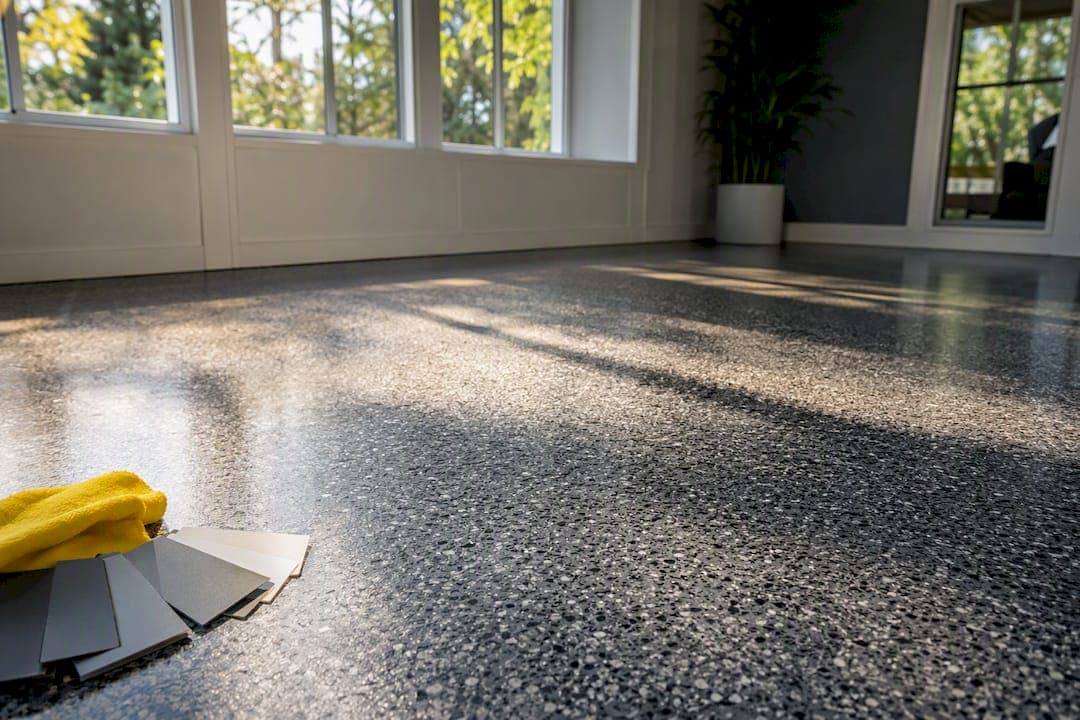
For most garages, a medium-toned flake blend is the safest epoxy floor color choice because it hides dirt, resists visible wear, and coordinates with almost any interior. Showroom floors and finished basements lean better toward neutral solids or subtle metallics, since those spaces get less abuse and more attention to design. Whatever direction you pick, lighting and sheen will change how that color actually reads once the floor is installed.
TL;DR:
- The most practical epoxy floor color for garages is a medium-toned flake blend that effectively hides dirt, stains, and surface imperfections.
- Surface preparation, especially diamond grinding, is critical for color durability and prevents peeling or blotching over time.
- UV-resistant topcoats, such as polyaspartic, are essential for maintaining color integrity in sun-exposed spaces.
- Custom color blending and sample viewing in your actual space significantly improve satisfaction and reduce costly mistakes.
- Higher-cost systems like metallic or quartz offer more visual impact or durability but require careful consideration of lighting and room use.
Table of Contents
- Epoxy Floor Colors: Solid, Flake, Metallic, or Quartz?
- Popular Epoxy Floor Color Palettes for Every Room
- How Lighting and Sheen Change the Way Color Looks
- Flake Sizes and Coverage: The Numbers Behind a Good Quote
- Maintenance and Durability: What Your Color Choice Costs You Later
- Choosing an Epoxy Floor Color: A Quick Checklist
- Why Surface Prep Determines How Long Your Color Lasts
- Does UV Exposure Fade or Yellow Epoxy Floor Colors?
- What Different Epoxy Floor Colors Actually Cost
- What's Trending in Epoxy Floor Colors Right Now
- Matching Epoxy Colors to Your Floor Prep Method
- Can You Mix Custom Epoxy Floor Colors?
- How Long Does Each Epoxy Color System Actually Last?
- The Real Trade-Off Nobody Explains Upfront
- Ready to See Your Colors in Person? Book a Consult
- Sources
Epoxy Floor Colors: Solid, Flake, Metallic, or Quartz?
Epoxy coatings come in four basic visual systems, and picking the wrong one for your space is the single most common regret homeowners bring up after installation. Each system trades appearance for practicality in a different way.
Solid-tint epoxy is a single flat color rolled or troweled across the floor. It looks clean and modern, but it shows every drip, tire mark, and dust particle almost immediately.
Broadcast flake systems, also called garage flake floor or flake epoxy garage systems, scatter colored paint chips into a wet basecoat, then seal them under a clear topcoat. This is the workhorse choice for garages because the mottled pattern conceals stains, sanding dust, and hairline cracks far better than a solid color.
Metallic pigments create swirling, three-dimensional effects that look almost like marble or lava when the light hits them right. They're stunning in a showroom but can read as gaudy in a working garage.
Quartz-aggregate systems embed colored sand-like granules for a textured, slip-resistant surface, and offer an especially wide range of color options and palettes for commercial-grade durability.
- Solid color: best for showrooms and low-traffic display floors, poor stain concealment
- Flake blend: best for garages and basements, excellent stain concealment, moderate cost
- Metallic: best for showroom or accent areas, dramatic look, higher glare and higher cost
- Quartz aggregate: best for commercial or high-slip-risk areas, excellent durability, higher material cost
Popular Epoxy Floor Color Palettes for Every Room
Most homeowners gravitate toward one of four palette families once they start browsing a garage epoxy color chart, and each one solves a different problem.
- Medium grays and granite-style blends. These full flake epoxy floor mixes are the closest thing to a default choice, and homeowner guides consistently point to gray and earth-tone blends as the most forgiving options for balancing looks with day-to-day upkeep.
- Earth tones (tan, brown, terracotta blends). These hide sawdust, oil residue, and general workshop grime better than almost anything else, and they warm up a space that would otherwise feel like a concrete box.
- Accent blues and themed blends. Popular in hobby garages, man caves, and coastal-style homes where the floor becomes part of the room's personality rather than just a surface underfoot.
- Metallic schemes. Best reserved for showroom floors, finished basements, or business lobbies where the goal is visual impact rather than daily abuse resistance. The glare trade-off is real: metallics reflect light dramatically, which looks incredible in a well-lit showroom and distracting in a small, harshly lit garage.
Stone-inspired flake blends are especially popular for pairing resinous flooring with a home's broader interior design, since they read as a natural material rather than a painted surface.
How Lighting and Sheen Change the Way Color Looks
The color chip you picked from a fan deck will not look identical on your actual floor, and that surprises more homeowners than anything else in the process. Gloss and metallic finishes amplify reflected light, which makes colors appear more saturated and can turn a subtle gray into something that looks almost silver under LED shop lights.
Satin and matte finishes tone that down. They reduce glare and, as a side benefit, hide minor surface imperfections like trowel lines or light scratches better than a high-gloss topcoat does.
Room size and window count matter just as much as the epoxy itself. Metallic finishes can feel overwhelming in a garage with several windows or bright overhead lighting, while dark solid colors tend to make small, dimly lit basements feel more cramped rather than sleek.
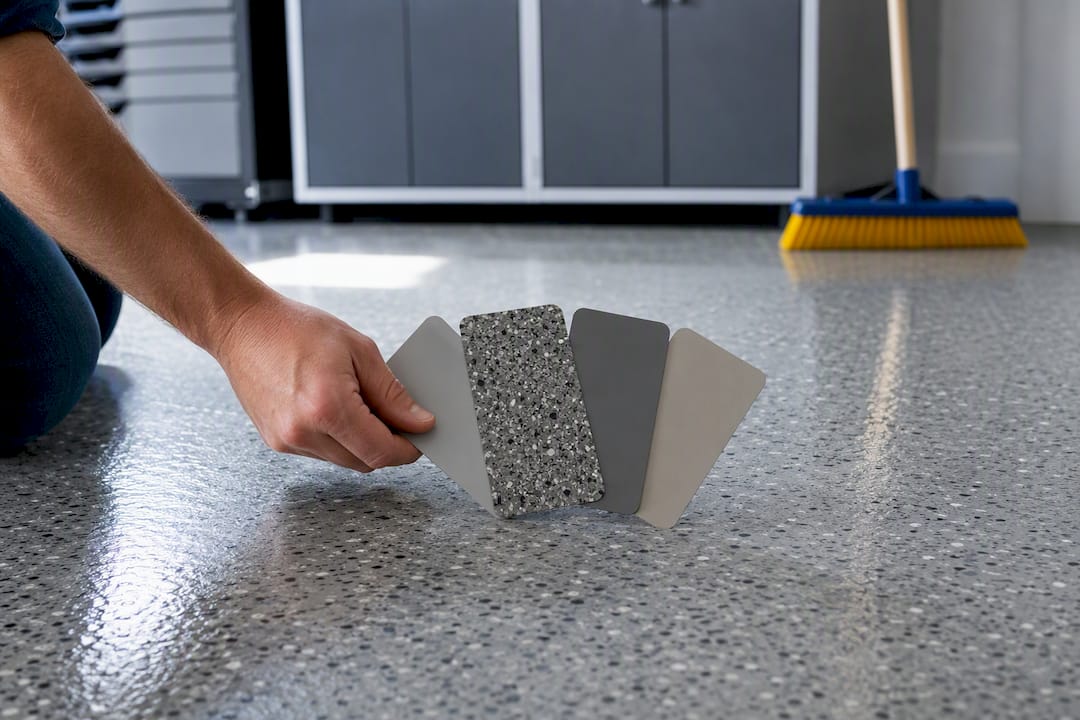
Pro Tip: Ask your installer for a physical sample chip and view it in your actual garage or basement at the time of day you use the space most. A color that looks perfect under a showroom's lighting can shift noticeably under your own fluorescent tubes.
Flake Sizes and Coverage: The Numbers Behind a Good Quote
Flake size affects both the final look and how much material your installer needs to order. Smaller flakes pack tighter for a fine, uniform texture, while larger flakes create a chunkier, more rustic pattern and typically use less material per square foot.
| Flake size | Visual effect | Approximate coverage |
|---|---|---|
| — | Fine, dense speckle | Coverage varies but usually requires more material per sq ft |
| — | Balanced, medium texture | Falls between the two extremes |
| 1/4 inch | Bold, chunky pattern | Coverage varies but typically requires less material per sq ft |
These coverage figures assume full broadcast to the point of saturation, where no basecoat is visible through the flake. If your existing concrete has visible cracks, patches, or heavy surface staining, specify a full broadcast rather than a partial one. Full coverage does a much better job of concealing repaired areas than a scattered, decorative flake pattern.
Maintenance and Durability: What Your Color Choice Costs You Later
The color and finish you choose today determines how often you'll be mopping later. Lighter solids and light gray solids show oil drips, tire marks, and dust trails fastest. Flake blends, particularly the busier, multi-color mixes, do a far better job of camouflaging everyday grime between cleanings.
Topcoat choice matters just as much as color. Standard epoxy topcoats can gradually yellow with sun exposure, while polyaspartic topcoats resist UV yellowing better and also cure faster, which matters for outdoor-facing garages and patios.
- Sweep or dust-mop weekly to prevent grit from scratching the topcoat.
- Wipe fresh oil or fluid spills immediately, since prolonged contact can dull gloss finishes.
- Use a pH-neutral cleaner for routine maintenance rather than harsh degreasers, which can etch the surface over time.
- Reapply a fresh topcoat every several years in high-traffic zones to restore sheen and UV protection.
Choosing an Epoxy Floor Color: A Quick Checklist
Before you commit to a color chip, walk through this list. It takes ten minutes and saves you from a color you'll regret in a year.
- Define the room's job. A garage that doubles as a workshop needs a stain-hiding flake blend; a showroom floor can afford a cleaner solid or metallic look.
- Assess your actual lighting. Count windows, note bulb type, and view samples at the time of day you'll use the space most.
- Decide on finish before color. Gloss, satin, and matte all shift how the same color reads, so lock this in alongside the color chip, not after.
- Set a realistic budget. Metallics and quartz aggregate cost more than solid or standard flake systems, both in material and labor.
- Ask about surface prep. Diamond grinding removes contaminants and opens the concrete's pores for a mechanical bond; a sprayed-on acid etch does not perform the same way over time.
- Confirm material specs. Ask whether the base is 100% solids epoxy and whether the topcoat is standard epoxy or polyaspartic.
- Get cure times and warranty in writing. Vague answers about "a few days" or an undefined warranty period are a red flag worth walking away from.
Watch for installers who skip prep details entirely or describe their materials only as "commercial-grade" without specifics. That vagueness usually means corners got cut somewhere you can't see.
Why Surface Prep Determines How Long Your Color Lasts
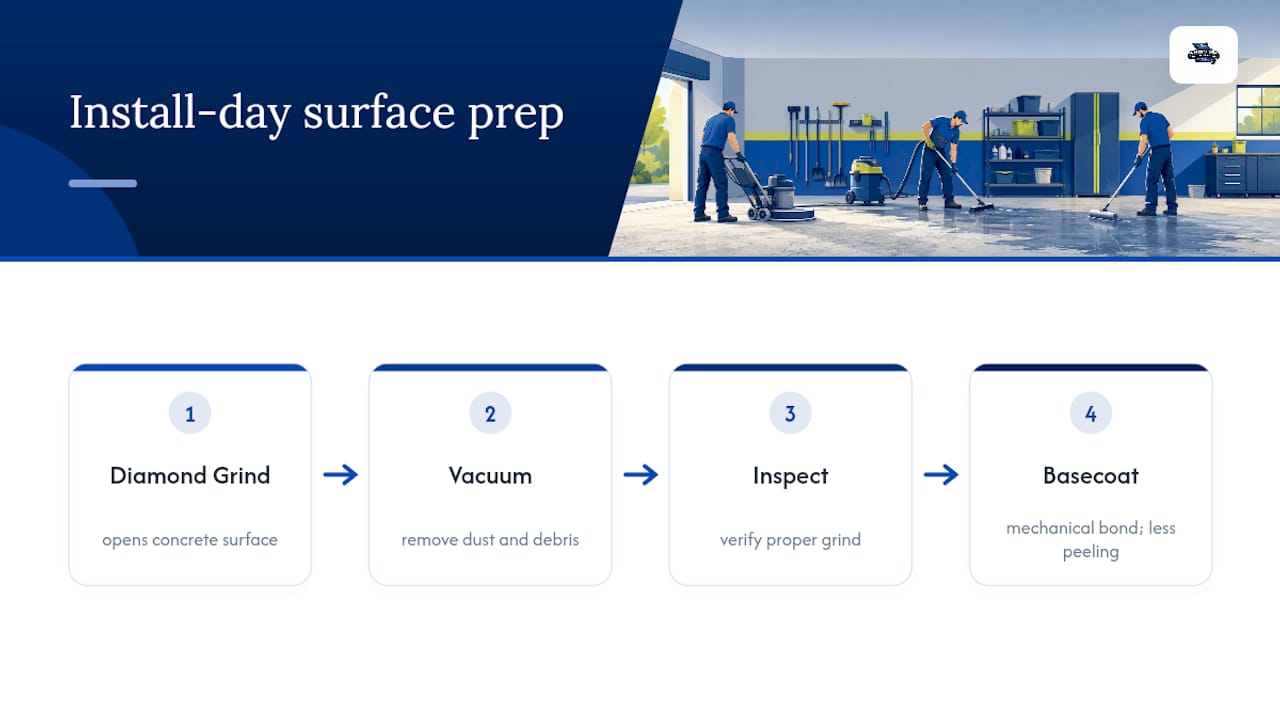
Diamond grinding matters more to your finished color than most homeowners realize. It mechanically opens the concrete's surface so the epoxy bonds into the slab rather than just sitting on top of it, which cuts down on peeling and delamination that can leave a floor looking patchy within a couple of years. An acid-etched or poorly prepped floor tends to fail unevenly, and when flake or pigment lifts in spots, no color choice can hide that kind of damage.
Show Me Epoxy builds every project around this diamond-grinding step before any color goes down, because a beautiful flake blend installed over an under-prepped slab is a short-term fix, not a floor. On install day, homeowners can expect the crew to grind, vacuum, and inspect the concrete before any basecoat touches the floor, with most residential garages finished in a single day or two depending on square footage. That kind of prep is also what makes a long-lasting garage floor realistic rather than aspirational.
Does UV Exposure Fade or Yellow Epoxy Floor Colors?
Direct sunlight is the enemy of standard epoxy topcoats, and it's the reason color choice and topcoat choice need to be decided together, not separately. Clear epoxy topcoats contain a chemical structure that breaks down under UV rays over time, which shows up as a yellowish tint developing across light-colored floors and a general dulling of darker ones.
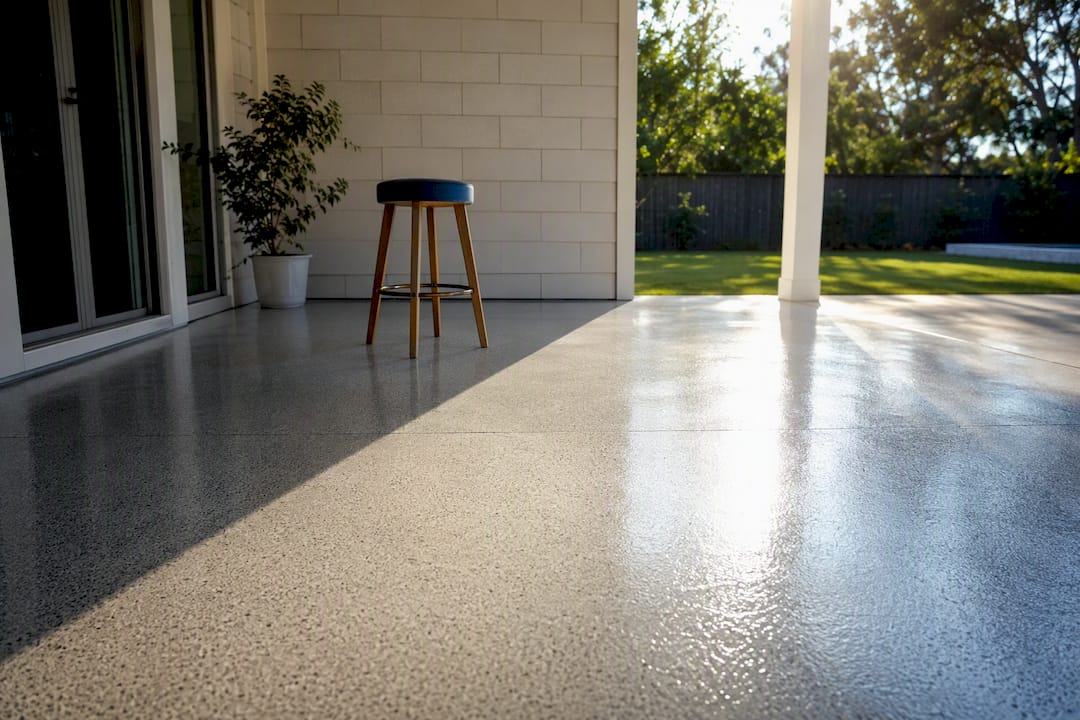
This matters most for garages with south-facing doors left open regularly, covered patios, and sunrooms, where UV exposure is constant rather than occasional. A crisp white or light gray solid color will show yellowing faster and more visibly than a busy flake blend, simply because there's more contrast between the original color and the yellowed cast.
Polyaspartic topcoats handle this better. They're formulated to resist UV breakdown, which is why installers increasingly use a hybrid approach: a 100% solids epoxy basecoat for adhesion and thickness, topped with a polyaspartic clear coat for UV resistance and faster cure. This combination gets you the strength of epoxy with the sun resistance epoxy alone doesn't offer.
If you're finishing an outdoor patio or a garage that gets serious sun through the bay door, ask your installer directly whether the topcoat is standard epoxy or polyaspartic. It's a five-second question that affects how your floor looks in five years, not just on install day.
What Different Epoxy Floor Colors Actually Cost
Color complexity drives cost more than most people expect going in. A single solid color is the cheapest option because it requires one pigment, one application pass, and no broadcast material. Flake blends cost more, since they require a base color, a full or partial flake broadcast, and often a slightly longer cure window between coats.
Metallic finishes sit at the higher end. The pigments themselves are more expensive, and achieving the swirling three-dimensional effect takes more installer skill and often a second color pass to get right. Quartz-aggregate systems carry a similar premium, since the colored aggregate itself costs more than paint chips and the application process is more labor-intensive.
Beyond the color system itself, three other factors move the price: square footage, the condition of your existing concrete (cracked or heavily stained slabs need more prep work regardless of color), and topcoat choice, since polyaspartic typically costs more than standard epoxy per square foot. A full broadcast flake floor to hide cracks or old stains will always run higher than a partial broadcast on a clean, crack-free slab, simply because it uses more material.
The honest advice here: don't chase the cheapest solid-color quote if your concrete has real damage. You'll likely pay for a second, more expensive fix later once the flaws show through.
What's Trending in Epoxy Floor Colors Right Now
Stone-inspired flake blends, the kind that mimic granite or natural aggregate, remain the dominant trend in garage flooring, largely because they photograph well and age gracefully compared to flat solid colors. Darker charcoal and graphite flake mixes have also picked up momentum, especially paired with satin topcoats for a more understated, modern-garage look rather than the glossy showroom effect that was popular a few years back.
Custom blended looks are showing up more often too, where homeowners mix two or three standard flake colors rather than choosing a single pre-packaged blend. This gives a wider range of texture and depth without moving into full metallic territory. Muted earth tones, terracotta and warm taupe especially, are gaining ground in basements and finished garage spaces where the goal is comfort rather than industrial polish.
If you're coordinating your floor with the rest of your home's palette, it helps to think about color the way you would for interior doors and trim, matching undertones rather than picking the floor in isolation. A warm-toned flake blend paired with cool-toned trim tends to look disjointed once both are finished.
Matching Epoxy Colors to Your Floor Prep Method
Not every epoxy color performs the same way over every surface preparation method, and this is where homeowners get surprised after the fact. Solid colors and light-toned finishes need the cleanest, most evenly prepped substrate, because any unevenness in the grind pattern, moisture level, or old coating residue shows through a flat single color almost immediately.
Flake blends are more forgiving. Since full broadcast is recommended for floors with visible imperfections, a busy flake pattern can mask minor prep inconsistencies far better than a solid tint can.
Diamond grinding remains the gold standard prep method regardless of which color system you choose, because it creates a mechanically sound surface that accepts pigment and flake evenly. Acid etching, an older and cheaper method, can leave inconsistent porosity across the slab, and that unevenness sometimes shows up as blotchy color absorption once the epoxy cures. If you're coating over existing concrete that already has an old coating or sealant on it, that layer typically needs to be fully ground away first. Epoxy doesn't bond reliably over most existing coatings, and skipping that step is one of the most common causes of early color blotching and peeling.
Can You Mix Custom Epoxy Floor Colors?
Yes, and this is where a garage floor stops looking like a kit and starts looking designed. Most manufacturers provide color charts and fan decks specifically so customers can preview standard combinations, but the real customization happens when you start mixing basecoat tint with a non-matching flake blend.
A neutral gray basecoat under a warm earth-tone flake, for instance, reads completely differently than that same flake over a black basecoat. Kit vendors typically show example patterns and recommended broadcast rates for these combinations, since the ratio of basecoat visibility to flake density changes the entire mood of the floor.
Custom blending isn't free, though. It usually means special-ordering flake mixes rather than using an installer's stock inventory, and it can add a few days to project timelines while materials arrive. If you're set on a specific look, ask to see a physical sample patch mixed to your actual specification before the crew starts, not just a photo from a supplier catalog. Photos shift color under different camera lighting far more than people expect, and a sample chip in your hand tells you the truth a photo can't.
How Long Does Each Epoxy Color System Actually Last?
Durability has less to do with pigment and more to do with what's underneath it, but color system still plays a role. Solid colors, especially in high-traffic areas, tend to show wear patterns (tire tracks, foot traffic paths) years before a flake blend does, simply because there's no pattern to break up the visual evidence of use.
Flake systems distribute wear more evenly across a busy pattern, which is part of why they remain the standard recommendation for active garages. Metallic finishes hold their dramatic look well in low-traffic showroom settings but can show scuffing more visibly in daily-use spaces, since scratches disrupt the smooth reflective surface that makes metallics look good in the first place. Quartz-aggregate floors tend to outlast all of them in raw wear resistance, which is part of why they show up so often in commercial and industrial settings rather than residential garages.
Topcoat still matters more than color for longevity. A well-chosen color over a properly prepped, polyaspartic-topped floor will outlast a gorgeous custom blend installed over a rushed, poorly ground slab. Color is the part everyone notices first. Prep and topcoat are what determine whether it still looks good in year eight.
The Real Trade-Off Nobody Explains Upfront
Most guides treat epoxy floor colors as a purely aesthetic decision, and that's the biggest gap in how this topic usually gets covered. Color is functional first. A gorgeous solid gray in a working garage will look worse in six months than a "boring" flake blend will look in six years, because the flake pattern was engineered to hide exactly the kind of wear a garage generates daily.
The conventional advice tends to lead with palettes and treat prep, topcoat, and lighting as afterthoughs. That order should be reversed. Get your surface prep and topcoat decisions locked first, because those choices determine how any color performs over time, then choose color within that framework rather than around it.
If there's one thing worth prioritizing above all else, it's viewing a real sample chip in your actual space before signing anything. Fan decks and online photos consistently mislead people about saturation and gloss. A five-minute test patch under your own lighting will tell you more than an hour of scrolling color charts ever will.
— Stephen
Ready to See Your Colors in Person? Book a Consult
Picking a color online only gets you so far. Showmeepoxy brings the flake and color samples to your actual garage or basement, under your actual lighting, so you're not guessing from a photo on a screen.

Every project starts with the same diamond-grinding prep, whether you're going with a modest gray flake blend or a full custom metallic look, because that's what keeps the color looking right for years instead of months. Combine that prep with 100% solids epoxy basecoats, polyaspartic topcoats where UV resistance matters, and installs that typically wrap up in a day or two, and you get a floor that holds its color instead of one that fades and peels by year three.
Some epoxy flooring companies offer on-site color consults with physical sample patches, pricing information, and quick turnaround for homeowners. Request your free quote and get a real look at how your chosen palette performs in your own space before you commit to anything.
Sources
- High Performance Flooring System Colors
- 13 Garage floor epoxy colors you weren't expecting to look so great
- Wholesale Garage Floor Flake for Contractors | 300+ Blends
- Color charts | Crown Polymers flooring finishes